




Spassky Cave Church in Russia
13 years ago


Super hero, but with different powers. Robot in India that much resembles the Iron Man, foretells your future.
Sadhu, or holy man, listen the prophecy of his destiny in the Mumbai market, on a robot who resemble a lot on a cartoon and film hero Iron Man.


The Internet giants say the bills could require your Internet provider to block websites that are involved in digital file sharing. And search engines such as Google, Yahoo and Bing could be stopped from linking to them -- antithetical, they say, to the ideal of an open Internet.
The whole explanation you can find on Wikipedia, or just click here.
 Orcas, or killer whales, positioned themselves prominently and made it clear they were the real experts -- and that no mere human on a surfboard was going to deny them whatever waves they wanted.
 Ingrid Visser, founder of the Orca Research Trust near Sandy Bay, said few sharp images of this phenomenon exist and that Cunningham's photos could be used in a research paper on the island nation's surfing orcas.
 However, that's also a sight to behold because their kick-outs, as the waves close out or get too close to land, are far more dramatic than those of ordinary surfers.
Not so fast, doubting Thomas. The video was followed up by a rather official-sounding backer: the 
"Amateur video depicting what could be one of the most elusive legendary creatures, the unicorn, has been captured on film by a Toronto resident. ... The Science Centre is reviewing the footage frame-by-frame to determine whether Hickey-Jones' claim is legitimate."
The center set up an emergency unicorn hotline for more information and sightings.
Could it be true? Could a unicorn exist?...
In a phone call yesterday to the center's media office, the spokeswoman predicted a new unicorn would be sighted sometime in November. Oh really? They're predicting their sightings now?The group just happens to have an new exhibition to promote "Mythic Creatures: Dragons, Unicorns & Mermaids" and, well, the unicorn sighting may have something to do with that, the spokeswoman conceded.
Way to ruin a dream, Ontario Science Center.
 Amateur video depicting what could be one of the most elusive legendary creatures, the unicorn, has been captured on film by a Toronto resident. The video in question, shot by a local birdwatcher, Peter Hickey-Jones, shows what appears to be a white horse with a single horn on its head emerging from the trees in the Don Valley wetland.
 "I was trying to film a pileated woodpecker when I saw what looked like a bright white horse in the distance. When I got a little closer, I noticed the horn on its head. I'm not one to jump to conclusions but I'm certain beyond the shadow of a doubt that what I saw was a unicorn. I'm 
Hickey-Jones brought the footage to the Ontario Science Centre to be analyzed by experts. The Science Centre is reviewing the footage frame-by-frame to determine whether Hickey-Jones' claim is legitimate. With closer examination, Science Centre staff is hoping to establish whether or not a genuine unicorn sighting has occurred.
Whether you’re after all-out luxury or sand-between-the-toes casual, there’s a romantic island for you. And while many of these dream destinations have “remote” and “secluded” as their principle selling points, others are surprisingly close to home. (One you can practically see from the Hollywood sign.)
No matter whether you’re a new couple just getting to know each other or you’re celebrating your golden anniversary, these romantic islands will help you holiday happily ever after.
Of the 1,192 islets that make up this island nation in the Indian Ocean, roughly 1,000 are uninhabited. Suffice to say, your chances of finding romantic seclusion are pretty high. Like most of the resorts here, the Conrad Maldives Hotel occupies its own private atoll, called Rangali Island. The romance factor kicks in before you even arrive, thanks to a seaplane ride over the shallow, impossibly clear lagoon. Soon enough, you’re dining in the underwater restaurant and kicking back in the over-water spa.
A conspicuous absence of international hotel chains is just one reason this idyll—situated east of Oahu in the Hawaiian archipelago—draws romantics from all over. Hike to remote waterfalls, kayak secluded rocky coastlines, and ride donkeys into the lush valleys, or just laze beachside. (Head for the golden sands of secluded three-mile-long Papohaku Beach, at the far-west end of the island.) With just one traffic light on the island, the only gridlock you’ll encounter is caused by colonies of curious sea turtles frolicking in the outrageously clear waters.
Sure, noon in Capri Town can be a tourist swarm, but the bulk of visitors depart on the last ferry back to Naples or Sorrento—leaving the island blissfully free for lovers. And this dramatically craggy outcrop, a Mediterranean Garden of Eden splashed with floral color and perfumed by lemon trees and herb gardens, has remained a magnet for the A-list since antiquity, when Emperor Tiberius set up camp here.
If the Caribbean Sea were a catwalk, St. Lucia would be its most bankable supermodel. This 27-mile-long island is lush, mountainous, and blessed with gorgeous beaches and verdant cocoa plantations. The jade-green twin peaks of the Pitons, jungle-swathed volcanic plugs that rise from a silvery ocean on the southwest coast, are the Caribbean’s most striking backdrop.
Located in the Caribbean Sea near the border with Costa Rica, this group of islands is all about low-key relaxation with a Latin American flavor, pitch-perfect for sybarites who don’t want to pack a designer bikini. The main island of Colon has a buzzy downtown full of waterfront bars and laid-back nightclubs, while the smaller islands offer deserted beaches, rainforests, mangroves, and coral reefs.
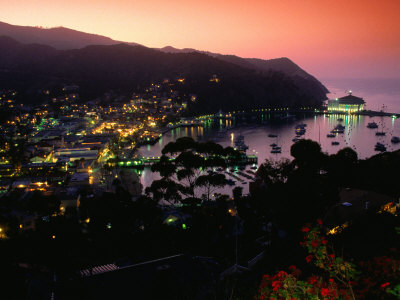
Just 22 miles southwest of Los Angeles, Santa Catalina has a certain Mediterranean flavor. Yachts jostle in a glinting harbor, sorbet-colored homes cascade down the hillside, and the secluded coves are ready-made for romance—including the aptly named Lover’s Cove, east of Avalon.
Sweeping views over a picture-perfect caldera—the result of a volcanic eruption around 1600 B.C.—is just one factor in Santorini’s romantic charm. Gorgeous, striated cliffs and black-sand beaches don’t hurt, either. Head to the famously picturesque village of Oia (book a room at the 18-suite Mystique) with its classic whitewashed, cliff-edge architecture, blue-domed churches, and stone houses overhung with bougainvillea canopies.
If your idea of Eden is unpaved roads, truly deserted beaches, and nary a nightclub, this 68-square-mile island in the Eastern Caribbean is for you. Barbuda features just a handful of high-end hotels, including Coco Point Lodge, on its own 164-acre peninsula fronting glorious pink-sand beaches. Take a boat trip to the Frigate Bird Sanctuary on a lagoon in the island’s northwest and ogle the 5,000 namesake birds that call it home.
The South Pacific fantasy of swaying palm trees and extravagantly lush scenery reaches its fullest expression here. There are just 25 cottages on this privately owned resort, which occupies the entire island, each with a private pool, dining pavilion, and outdoor hot tub and shower. While the resort attracts deep-pocketed travelers, don’t expect glitzy lobbies. The emphasis is on rustic, pared-back luxury; every detail seems crafted to appeal to couples, including the lagoon pool with its man-made “islands” big enough for two.
You’ll find only one resort here—Amanpulo, set on its own private island southwest of Manila with just 40 secluded pitched-roof traditional villas, strung along a pristine beach with sand so white it’s blinding. Beachcombers can navigate the entire island on foot in less than two hours, keeping their eyes out for baby sharks, kingfishers, and sea turtles, which lay their eggs here between March and October.
Hidden in a Hubble Space Telescope photo released earlier this year is a small smudge of light that European astronomers now calculate is a galaxy from 13.1 billion years ago. That's a time when the universe was very young, just shy of 600 million years old. That would make it the earliest and most distant galaxy seen so far.
By now the galaxy is so ancient it probably doesn't exist in its earlier form and has already merged into bigger neighbors, said Matthew Lehnert of the Paris Observatory, lead author of the study published online Wednesday in the journal Nature.

While Ellis finds the basis for the study "pretty good," there have been other claims about the age of distant space objects that have not held up to scrutiny. And some experts have questions about this one. But even the skeptics praised the study as important and interesting.
The European astronomers calculated the age after 16 hours of observations from a telescope in Chile that looked at light signatures of cooling hydrogen gas.
Earlier this year, astronomers had made a general estimate of 600 to 800 million years after the Big Bang for the most distant fuzzy points of light in the Hubble photograph, which was presented at an astronomy meeting back in January.
In the new study, researchers focused on a single galaxy in their analysis of hydrogen's light signature, further pinpointing the age. Garth Illingworth of the University of California, Santa Cruz, who was the scientist behind the Hubble image, said it provides confirmation for the age using a different method, something he called amazing "for such faint objects."
The new galaxy doesn't have a name — just a series of letters and numbers. So Lehnert said he and colleagues have called it "the high red-shift blob. "Because it takes so long for the light to travel such a vast time and distance, astronomers are seeing what the galaxy looked like 13.1 billion years ago at a time when it was quite young — maybe even as young as 100 million years old — Lehnert said. It has very little of the carbon or metal that we see in more mature stars and is full of young, blue massive stars, he said.
What's most interesting to astronomers is that this finding fits with theories about when the first stars and galaxies were born. This galaxy would have formed not too soon after them.
"We're looking almost to the edge, almost within 100 million years of seeing the very first objects," Ellis said. "One hundred million years to a human seems an awful long time, but in astronomical time periods, that's nothing compared to the life of the stars."
 With the upcoming disaster film "2012" and the current hype about Mayan calendars and doomsday predictions, it seems like a good time to put such notions in context.
 Most prophets of doom come from a religious perspective, though the secular crowd has caused its share of scares as well. One thing the doomsday scenarios tend to share in common: They don't come to pass.
Here are 10 that didn't pan out, so far:
1.The Prophet Hen of Leeds, 1806
History has countless examples of people who have proclaimed that the return of Jesus Christ is imminent, but perhaps there has never been a stranger messenger than a hen in the English town of Leeds in 1806. It seems that a hen began laying eggs on which the phrase "Christ is coming" was written. As news of this miracle spread, many people became convinced that doomsday was at hand — until a curious local actually watched the hen laying one of the prophetic eggs and discovered someone had hatched a hoax.
2.The Millerites, April 23, 1843
A New England farmer named William Miller, after several years of very careful study of his Bible, concluded that God's chosen time to destroy the world could be divined from a strict literal interpretation of scripture. As he explained to anyone who would listen, the world would end some time between March 21, 1843 and March 21, 1844. He preached and published enough to eventually lead thousands of followers (known as Millerites) who decided that the actual date was April 23, 1843. Many sold or gave away their possessions, assuming they would not be needed; though when April 23 arrived (but Jesus didn't) the group eventually disbanded—some of them forming what is now the Seventh Day Adventists.
3.Mormon Armageddon, 1891 or earlier
Joseph Smith, founder of the Mormon church, called a meeting of his church leaders in February 1835 to tell them that he had spoken to God recently, and during their conversation he learned that Jesus would return within the next 56 years, after which the End Times would begin promptly.
4.Halley's Comet, 1910
In 1881, an astronomer discovered through spectral analysis that comet tails include a deadly gas called cyanogen (related, as the name imples, to cyanide). This was of only passing interest until someone realized that Earth would pass through the tail of Halley's comet in 1910. Would everyone on the planet be bathed in deadly toxic gas? That was the speculation reprinted on the front pages of "The New York Times" and other newspapers, resulting in a widespread panic across the United States and abroad. Finally even-headed scientists explained that there was nothing to fear.
5.Pat Robertson, 1982
In May 1980, televangelist and Christian Coalition founder Pat Robertson startled and alarmed many when — contrary to Matthew 24:36 ("No one knows about that day or hour, not even the angels in heaven...") he informed his "700 Club" TV show audience around the world that he knew when the world would end. "I guarantee you by the end of 1982 there is going to be a judgment on the world," Robertson said.
6.Heaven's Gate, 1997
When comet Hale-Bopp appeared in 1997, rumors surfaced that an alien spacecraft was following the comet — covered up, of course, by NASA and the astronomical community. Though the claim was refuted by astronomers (and could be refuted by anyone with a good telescope), the rumors were publicized on Art Bell's paranormal radio talk show "Coast to Coast AM." These claims inspired a San Diego UFO cult named Heaven's Gate to conclude that the world would end soon. The world did indeed end for 39 of the cult members, who committed suicide on March 26, 1997.
7.Nostradamus, August 1999
The heavily obfuscated and metaphorical writings of Michel de Nostrdame have intrigued people for over 400 years. His writings, the accuracy of which relies heavily upon very flexible interpretations, have been translated and re-translated in dozens of different versions. One of the most famous quatrains read, "The year 1999, seventh month / From the sky will come great king of terror." Many Nostradamus
devotees grew concerned that this was the famed prognosticator's vision of Armageddon.
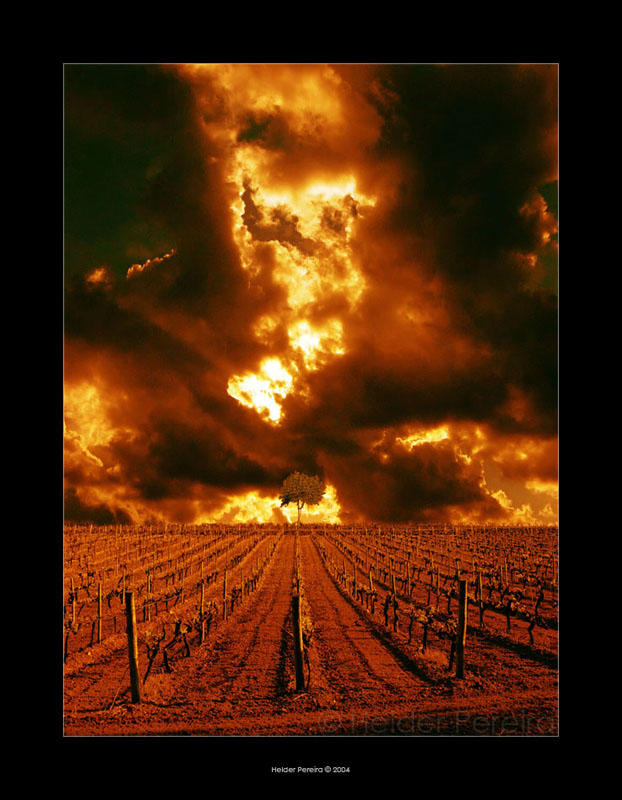
As the last century drew to a close, many people grew concerned that computers might bring about doomsday. The problem, first noted in the early 1970s, was that many computers would not be able to tell the difference between 2000 and 1900 dates. No one was really sure what that would do, but many suggested catastrophic problems ranging from vast blackouts to nuclear holocaust. Gun sales jumped and survivalists prepared to live in bunkers, but the new millennium began with only a few glitches.
9.May 5, 2000
In case the Y2K bug didn't do us in, global catastrophe was assured by Richard Noone, author of the 1997 book "5/5/2000 Ice: the Ultimate Disaster." According to Noone, the Antarctic ice mass would be three miles thick by May 5, 2000 — a date in which the planets would be aligned in the heavens, somehow resulting in a global icy death (or at least a lot of book sales). Perhaps global warming kept the ice age at bay.
10.God's Church Ministry, Fall 2008
According to God's Church minister Ronald Weinland, the end times are upon us-- again. His 2006 book "2008: God's Final Witness" states that hundreds of millions of people will die, and by the end of 2006, "there will be a maximum time of two years remaining before the world will be plunged into the worst time of all human history. By the fall of 2008, the United States will have collapsed as a world power, and no longer exist as an independent nation." As the book notes, "Ronald Weinland places his reputation on the line as the end-time prophet of God."

A new critique, published as a chapter in the new textbook "Calendars and Years II: Astronomy and Time in the Ancient and Medieval World" (Oxbow Books, 2010), argues that the accepted conversions of dates from Mayan to the modern calendar may be off by as much as 50 or 100 years. That would throw the supposed and overhyped 2012 apocalypse off by decades and cast into doubt the dates of historical Mayan events. (The doomsday worries are based on the fact that the Mayan calendar ends in 2012, much as our year ends on Dec. 31.)
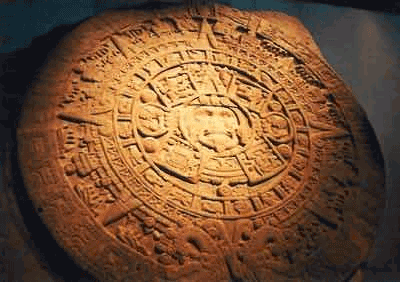
Later, the GMT constant was bolstered by American linguist and anthropologist Floyd Lounsbury, who used data in the Dresden Codex Venus Table, a Mayan calendar and almanac that charts dates relative to the movements of Venus.

But according to Aldana, Lounsbury's evidence is far from irrefutable.
"If the Venus Table cannot be used to prove the FMT as Lounsbury suggests, its acceptance depends on the reliability of the corroborating data," he said. That historical data, he said, is less reliable than the Table itself, causing the argument for the GMT constant to fall "like a stack of cards."
Aldana doesn't have any answers as to what the correct calendar conversion might be, preferring to focus on why the current interpretation may be wrong. Looks like end-of-the-world theorists 
LiveScience.com chronicles the daily advances and innovations made in science and technology. We take on the misconceptions that often pop up around scientific discoveries and deliver short, provocative explanations with a certain wit and style. Check out our science videos, Trivia & Quizzes and Top 10s. Join our community to debate hot-button issues like stem cells, climate change and evolution. You can also sign up for free newsletters, register for RSS feeds and get cool gadgets at the LiveScience Store.
Residents of Iztapalapa cooked up a 230-foot-long, almost 1½-ton enchilada on Sunday. Guinness record official Ralph Hannah announced that it was the world's biggest.
The colossal concoction was made of corn tortillas, white onions, serrano chilis, green tomatoes, avocado, cheese, cream and a sea of salsas, among other ingredients.
"With this Guinness record we are showing the world that Iztapalapa is a high-level tourist destination," said Mexico City tourism secretary Alejandro Rojas.
Mexico City has gone for a number of world records recently, including the largest number of people dancing Michael Jackson's "Thriller" and most people kissing simultaneously.
The world's largest enchilada is the latest food to enter the Guinness Book of Records thanks to its impressive size.
Last year a cafe in Sydney, Australia, created the world's biggest burger, weighing in at 15 stone.
The world's longest hot dog was assembled in 2006 in Japan, measuring a mighty 198 feet long.
 Columbus Day some states declare this day as the Columbus Day holiday and people enjoy a day off from work and students don’t go to schools, on the other hand some of the states of the country don’t recognize this day and everything goes normally and no Columbus Day holiday is celebrated. The very reason for all this is that the exact birth date of Christopher Columbus is not known, according to people it is between the twenty fifth of August and the thirty first of October. We don’t know the exact date of birth of the discoverer of the American continent. In the most parts of the country the jobs that are affiliated with the American government are closed on the 11th of October. The 11th of October has been decided as the Columbus Day and normally this day is declared a holiday, but many organizations and states don’t recognize this day. The stocks will remain open today and if you also work in such a place then you have to go to work today, this shows that the corporate world does not recognize the Columbus Day. The United States is actually not the only one that is going to celebrate the Columbus Day today, many of other countries that include several of the European countries will also celebrate the Columbus Day.



BEIJING -- Top-seeded Novak Djokovic beat David Ferrer of Spain 6-2, 6-4 on Monday to successfully defend his China Open title.
The world No. 2 cruised through the first set of a match that had been rained out Sunday, before falling behind 4-2 in the second.
At 4-3, the eighth-ranked Ferrer battled to hold serve and defend his lead, but Djokovic was relentless, breaking him to take the set and, two games later, the match.
"I started off really well but then I lost the momentum, I kind of lost the rhythm, got him back into the match with some unforced errors," said Djokovic, who converted four of six break points while being broken only once to wrap up his second title of the season.

Djokovic, runner-up at last month's U.S. Open, said he was pleased with his improved serve, which he says is largely responsible for the run of success he's experienced since Wimbledon.
The 23-year-old had somewhat more difficulty accounting for his success in Beijing, where he won the Olympic bronze medal in 2008 in addition to his back-to-back China Open titles. The playing surface -- and the local cuisine -- seem to suit his style of play, Djokovic said.
"There's something special about this place."
Djokovic now moves on to the ATP Masters in Shanghai, where he will face either Ivan Ljubicic of Croatia or Chinese qualifier Zhang Ze on Wednesday.
"This is definitely a confidence boost for me. The last two, three months ... feeling much more comfortable and confident on the court, playing the aggressive game and service is working for me which is a great thing to have," he said. "Let's see if I can keep it up. Energy-wise, I'm fresh."
Ferrer has less time to rest with a match against Frenchman Michael Llodra in Shanghai on Tuesday. He also pointed to the eighth game of the second set as having decided Monday's match.
"I had my chance there, but didn't do it," said the 28-year-old, who entered the final after beating Ljubicic in three sets in Saturday's semifinals. "Maybe when I lost this game, I lost a little bit my concentration and couldn't come back and play regular again."
New world No. 1 Caroline Wozniacki plays No. 3 Vera Zvonareva later Monday for the women's title. Zvonareva has won three of their previous five meetings.
The Simpsons, Thursday 21 October, 1930BST, Sky 1 HD and Sky 1
UK graffiti artist Banksy has created a controversial title sequence for long-running US animation The Simpsons.
The intro, which was shown in the US on Sunday, opens with the street artist's tag scrawled across the town of Springfield.
It closes with a minute-long sequence showing dozens of sweatshop workers in a warehouse painting cartoon cells and making Simpsons merchandise.
The episode, called MoneyBart, will be shown in the UK on 21 October.
It is the first time an artist has been invited to storyboard part of the show.
The extended sequence was apparently inspired by reports the show outsources the bulk of their animation to a company in South Korea.
Delays and disputes
It features Bart Simpson with his face covered as he writes all over his classroom walls.
While in the sweatshop, kittens are thrown into a wood chipper so their fur can be used to stuff Bart Simpson dolls and a chained unicorn is used to punch holes in Simpsons DVDs.
According to the street artist, his storyboard led to delays, disputes over broadcast standards and a threatened walk out by the animation department.
"This is what you get when you outsource," joked The Simpsons executive producer Al Jean.
Other famous Britons to have contributed to the show include Tony Blair, Simon Cowell and Ricky Gervais.
Gervais also wrote Homer Simpson, This Is Your Wife in 2006, and is to make another appearance on the show next year.
WASHINGTON – A "hidden" language spoken by only about 1,000 people has been discovered in the remote northeast corner of India by researchers who at first thought they were documenting a dialect of the Aka culture, a tribal community in the foothills of the Himalayas.
They found an entirely different vocabulary and linguistic structure.
Even the speakers of the tongue, called Koro, did not realize they had a distinct language, linguist K. David Harrison said Tuesday.
Culturally, the Koro speakers are part of the Aka community in India's Arunachal Pradesh state, and Harrison, associate professor of linguistics at Swarthmore College, said both groups merely considered Koro a dialect of the Aka language.
But researchers studying the groups found they used different words for body parts, numbers and other concepts, establishing Koro as a separate language, Harrison said.
"Koro is quite distinct from the Aka language," said Gregory Anderson, director of the Living Tongues Institute for Endangered Languages. "When we went there we were told it was a dialect of Aka, but it is a distant sister language."

The region where they live in the foothills of the Himalaya Mountains requires a special permit to enter. There, the researchers crossed a mountain river on a bamboo raft and climbed steep hillsides to to reach the remote villages, going door-to-door among the bamboo houses that sit on stilts.
Harrison and Anderson spoke at a news conference organized by the National Geographic Society, which supported their work.
The northeast corner of India is known as a hotspot of language diversity and researchers were documenting some of the unwritten tongues when they came across Koro in research started in 2008.
The timing of their discovery was important.
"We were finding something that was making its exit, was on its way out. And if we had waited 10 years to make the trip, we might not have come across close to the number of speakers we found," said Anderson.
Previously undocumented languages are "noticed from time to time" Harrison said, so such a discovery is not rare. But at the same time linguists estimate that a language "dies" about every two weeks with the loss of its last speakers.
Counting Koro there are 6,910 documented languages in the world, Harrison said. But he added that is really just a best estimate that can change regularly.
Many languages around the world are considered endangered, including Koro, he explained, because younger people tend to shift to the more dominant language in a region.
Unusually, Koro has been maintained within the Aka community, the researchers said, even though there is intermarriage and the groups share villages, traditions, festivals and food. In addition to the estimated 800 to 1,200 Koro speakers, the West Kameng and East Kameng districts of Arunachal Pradesh contain 4,000 to 6,000 Aka speakers.
The Koro speakers "consider themselves to be Aka tribally, though linguistically they are Koro. It's an unusual condition, such arrangement doesn't usually allow for maintenance of the minor language," Anderson said.
The threat, however, is from the spread of Hindi, a dominant language in India, and many youngsters go to boarding schools where they learn Hindi or English.
The researchers said they hope to figure out how the Koro language managed to survive within the Aka community.
They said Koro is a member of the Tibeto-Burman language family, a group of some 400 languages that includes Tibetan and Burmese. While Koro differs from Aka, it does share some things with another language, Tani, which is spoken farther to the east.
The research was started in 2008 to document two little known languages, Aka and Miji, and the third language, Koro, was discovered in that process.
"We didn't have to get far on our word list to realize it was extremely different in every possible way," Harrison said.
They said Koro's inventory of sounds was completely different, and so was the way sounds combine to form words. Words also are built differently in Koro, as are sentences.
The Aka word for "mountain" is "phu," while the Koro word is "nggo." Aka speakers call a pig a "vo" while to Koro speakers, a pig is a "lele."
"Koro could hardly sound more different from Aka," reported Harrison, author of a new book "The Last Speakers," about vanishing languages. Joining the two was linguist Ganesh Murmu of Ranchi University in India.
The researchers detail Koro in a scientific paper to be published in the journal Indian Linguistics.
LIMA (Reuters) – Archaeologists say scrawl on the back of a letter recovered from a 17th century dig site reveals a previously unknown language spoken by indigenous peoples in northern Peru.

"Our investigations determined that this piece of paper records a number system in a language that has been lost for hundreds of years," Jeffrey Quilter, an archaeologist at Harvard's Peabody Museum of Archaeology and Ethnology, told Reuters.
A photograph of the letter recently released by archaeologists shows a column of numbers written in Spanish and translated into a language that scholars say is now extinct.
"We discovered a language no one has seen or heard since the 16th or 17th century," Quilter said, adding that the language appears to have been influenced by Quechua, an ancient tongue still spoken by millions of people across the Andes.
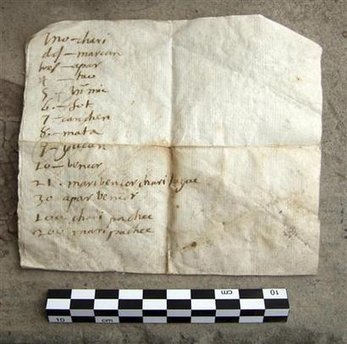
So far no record of the pescadora language has been found.
The letter, buried in the ruins of the Magdalena de Cao Viejo church at the El Brujo Archaeological Complex in northern Peru, was discovered in 2008.
But Quilter said archaeologists decided to keep their discovery secret until the research showing evidence of the lost language was published this month in the journal American Anthropologist.
"I think a lot of people don't realise how many languages were spoken in pre-contact times," Quilter said. "Linguistically, the relationship between the Spanish conquistadors and the indigenous was very complex."


