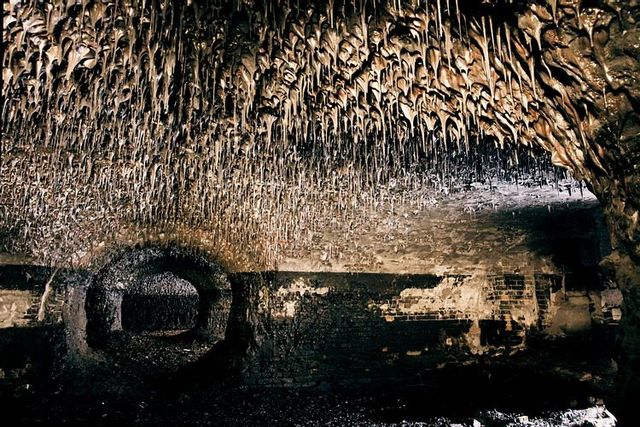


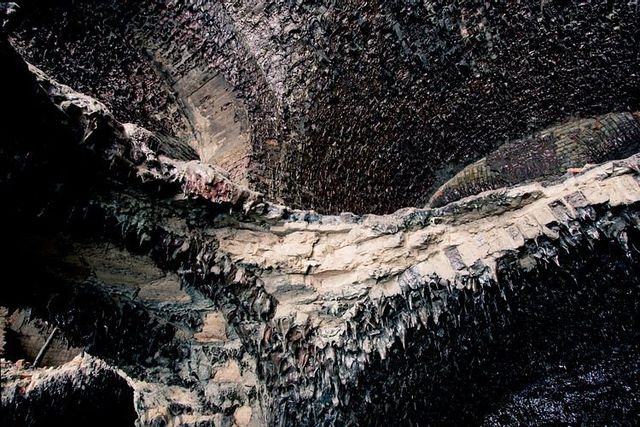
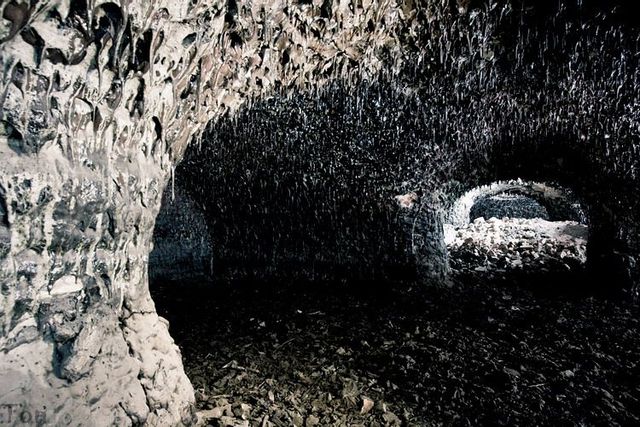
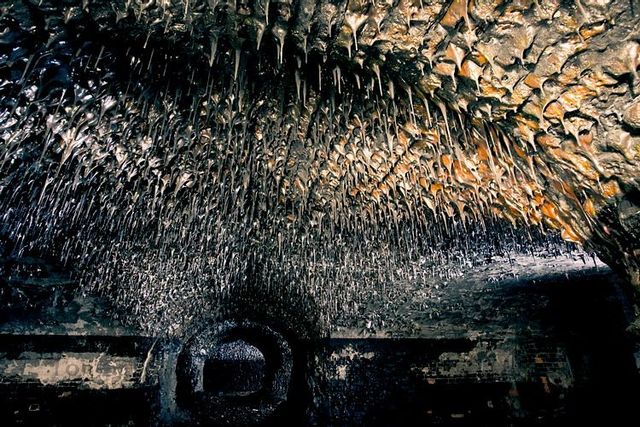
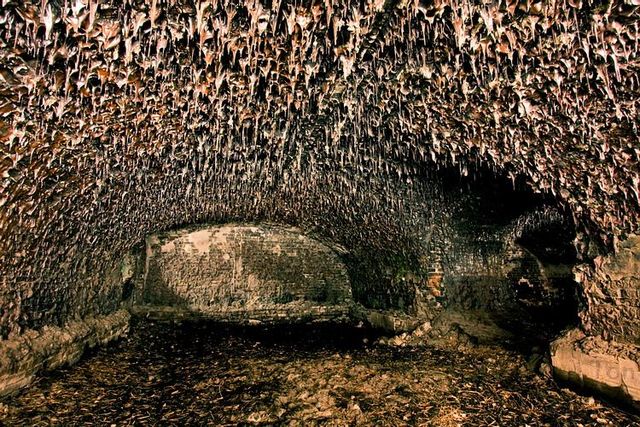
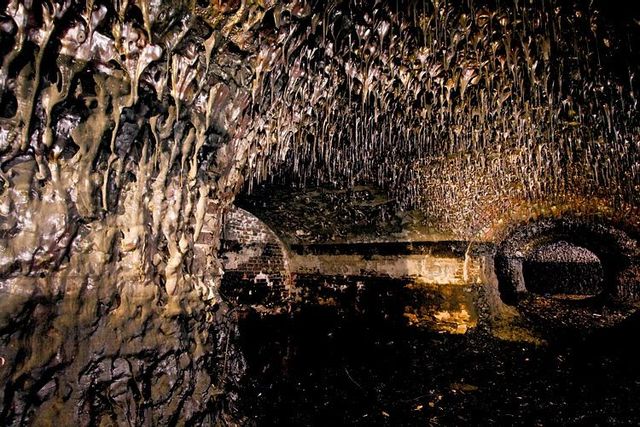
Spassky Cave Church in Russia
14 years ago

Researchers have discovered the fossilised remains of an ancient whale with huge, fearsome teeth.
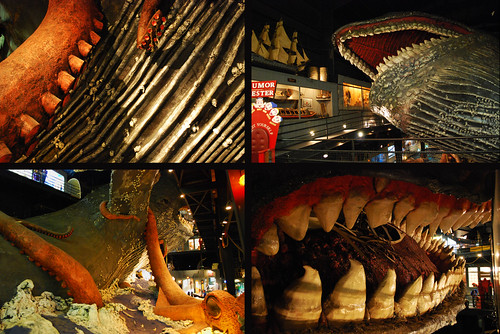 A Peruvian desert has turned out to be the final resting place of an ancient sperm whale with teeth much bigger than those of the largest of today's sperm whales. The fossil, dated at 12–13 million years old, belongs to a new, but extinct, genus and species described in Nature today1. Named Leviathan melvillei, it probably hunted baleen whales. A team of researchers recovered 75% of the animal's skull, complete with large fragments of both jaws and several teeth. On the basis of its skull length of 3 metres, they estimate that Leviathan was probably 13.5–17.5 metres long, within the range of extant adult male sperm whales (Physeter macrocephalus). Its largest teeth, however, are more than 36 centimetres long — nearly 10
 centimetres longer than the largest recorded Physeter tooth.
 penned Moby-Dick — "one of my favourite sea books", says lead author Olivier Lambert of the National Museum of Natural History in Paris.

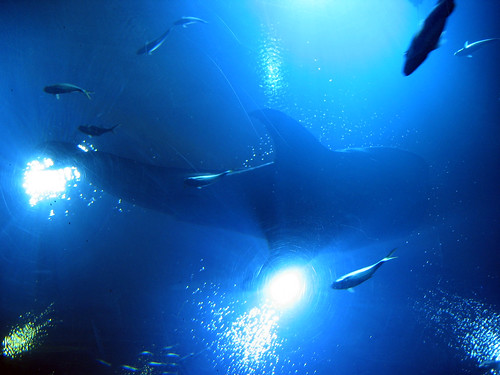 All sperm whales have characteristically large foreheads to hold their 'spermaceti organ', a series of oil and wax reservoirs buttressed with massive partitions of connective tissue. Scientists have long thought that this organ helps sperm whales to dive deeply to feed. The curved 'basin' atop Leviathan 's snout suggests that it also had a large spermaceti organ, even though it probably did not dive to feed. The authors speculate that, if Leviathan hunted baleen whales near the surface, the large spermaceti organ existed long before modern sperm whales became specialized for foraging squid at depth.

Carley was heading home to Milwaukee after visiting her father in Atlanta with sisters Annie, 13, and Rebecca, 22, when the flap unfolded.
Rebecca said the three were led onto the jetway and told they'd have to get rid of the baby red ear slider -- named Neytiri after the princess in the movie "Avatar" -- if they wanted to reboard.
"I asked, 'What do you mean get rid of it?' and they said throw it away," she said. "I was very sad, and I felt bad for my littlest sister because it was her first pet and she was planning to take care of it herself."
While the sisters say they were told to put the animal in the trash, AirTran says they chose that themselves, despite an offer to fly later at no extra charge.
AirTran company policy bars animals other than cats, dogs and household birds in the cabin, said spokesman Christopher White. White cited a Centers for Disease Control and Prevention report that says the reptiles have been known to carry salmonella bacteria.
The sisters say they made it past security screeners and an AirTran gate agent before boarding. One flight attendant told them to stow the cage under their seat, they say.
But with the flight rolling toward its takeoff, an attendant told them the turtle wasn't allowed in the cabin.
Rebecca Helm called their father, and he began driving back to the airport. She asked an AirTran employee to make arrangements with her father to look after the pet until he could get there, but the employee refused.
"I basically had to make a really fast decision because the whole plane was being delayed," Rebecca Helm said. The bin wasn't very full and she thought the turtle could be found easily once her dad arrived, she said.
Rebecca twice declined the offer to take a later flight, White said.
"We don't have the personnel or the facilities to care for people's pets," White said.
Rebecca asked if throwing the pet away would allow for them to get back on the flight, White said. The gate agent did not tell the sisters what to do but said they could not get on the plane with the turtle, White said.
"At no time did any AirTran Airways crew member order or suggest that they put the turtle in the trash," he said.
Half an hour later, the sisters' father called, saying he wanted to come look through the trash, White said. The gate agent looked, couldn't find the turtle and assumed it had been emptied, he said.
The airline, a unit of AirTran Holdings Inc. discovered Wednesday that the ramp supervisor had rescued the turtle from the trash "out of his own compassion" and given it to another crew member, who took it home for her 5-year-old son, White said.
AirTran told that crew member the original owners wanted it back, and the airline arranged for the turtle to fly as cargo to Milwaukee on Thursday, White said.
The sisters' mother reported what happened to animal rights group PETA, which sent a letter to AirTran demanding an investigation and disciplinary action.
For their part, Rebecca Helm says her sisters "are very happy to have the turtle back."
 Researchers at the space agency believe they have discovered vital clues that appeared to indicate that primitive aliens could be living on the planet. Data from Nasa's Cassini probe has analysed the complex chemistry on the surface of Titan, which experts say is the only moon around the planet to have a dense atmosphere.
 the moon is generally too cold to support even liquid water on its surface. The research has been detailed in two separate studies. The first paper, in the journal Icarus, shows that hydrogen gas flowing throughout the planet’s atmosphere disappeared at the surface. This suggested that alien forms could in fact breathe. The second paper, in the Journal of Geophysical Research, concluded that there was lack of the chemical on the surface. Scientists were then led to believe it had been possibly consumed by life. Researchers had expected sunlight interacting with chemicals in the atmosphere to produce acetylene gas. But the Cassini probe did not detect any such gas. Chris McKay, an astrobiologist at Nasa Ames Research Centre, at Moffett Field,
 California who led the research, said: “We suggested hydrogen consumption because it's the obvious gas for life to consume on Titan, similar to the way we consume oxygen on Earth. "If these signs do turn out to be a sign of life, it would be doubly exciting because it would represent a second form of life independent from water-based life on Earth.” Professor John Zarnecki, of the Open University, added: “We believe the chemistry is there for life to form. It just needs heat and warmth to kick-start the process. “In four billion years’ time, when the Sun swells into a red giant, it could be paradise on Titan.” They warned, however, that there could be other explanations for the findings. But taken together, they two indicate two important conditions necessary for methane-based life to exist.

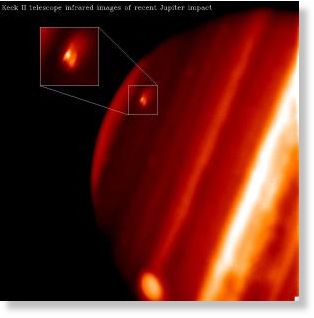 the mystery behind a strange “bruise” on Jupiter. Using an infrared telescope on Hawaii, Nasa scientists found evidence that Jupiter was apparently struck near its south pole, and credited Wesley. Mr Wesley, from Broken Hill, in central Australia, first spotted the scar the size of the Pacific Ocean that was left near Jupiter's south pole last year. Using an infrared telescope on Hawaii, NASA scientists found evidence that Jupiter was struck, crediting Mr Wesley. Follow-up observations made with the Hubble space telescope suggested it was made by an asteroid with a force equivalent to a few thousand nuclear bombs. Hubble is certain to be switched from other duties again to photograph Jupiter and give professional astronomers as much information as possible about the new collision. The latest hit near the equator has not left any visible mark so far, but astronomers are on the lookout. The absence of a detectable “gash”, and the short impact time, has led scientists to believe Jupiter was likely struck by a meteor. "We've never seen a meteor slam into Jupiter," said Glenn Orton of Nasa's Jet Propulsion Laboratory. With these impacts now apparently less rare than once imagined, astronomers will also be re-examining observations of light and dark spots on Jupiter in historical records. In 1686, Italian astronomer Giovanni Cassini noted a dark spot on Jupiter that was about the same size as the largest bruise seen after Comet Shoemaker-Levy hit the planet in 1994. A British Astronomer Royal, George Airy, saw another dark spot that recorded as being nearly four times bigger than shadows cast by Jupiter's main Galilean moons.


