
Spassky Cave Church in Russia
13 years ago


In following with our decision to skip .torrent-files in the nearby future one of the biggest steps will come on the 29th of February. We will stop serving .torrent-files for all torrents that has has more than 10 peers from this date.


The Internet giants say the bills could require your Internet provider to block websites that are involved in digital file sharing. And search engines such as Google, Yahoo and Bing could be stopped from linking to them -- antithetical, they say, to the ideal of an open Internet.
The whole explanation you can find on Wikipedia, or just click here.
WASHINGTON – A "hidden" language spoken by only about 1,000 people has been discovered in the remote northeast corner of India by researchers who at first thought they were documenting a dialect of the Aka culture, a tribal community in the foothills of the Himalayas.
They found an entirely different vocabulary and linguistic structure.
Even the speakers of the tongue, called Koro, did not realize they had a distinct language, linguist K. David Harrison said Tuesday.
Culturally, the Koro speakers are part of the Aka community in India's Arunachal Pradesh state, and Harrison, associate professor of linguistics at Swarthmore College, said both groups merely considered Koro a dialect of the Aka language.
But researchers studying the groups found they used different words for body parts, numbers and other concepts, establishing Koro as a separate language, Harrison said.
"Koro is quite distinct from the Aka language," said Gregory Anderson, director of the Living Tongues Institute for Endangered Languages. "When we went there we were told it was a dialect of Aka, but it is a distant sister language."
 People of the Aka culture live in small villages near the borders of China, Tibet and Burma (also known as Myanmar). They practice subsistence hunting, farming and gathering firewood in the forest and tend to wear ornate clothing of hand-woven cloth, favoring red garments. Their languages are not well known, though they were first noted in the 19th century.
The region where they live in the foothills of the Himalaya Mountains requires a special permit to enter. There, the researchers crossed a mountain river on a bamboo raft and climbed steep hillsides to to reach the remote villages, going door-to-door among the bamboo houses that sit on stilts.
Harrison and Anderson spoke at a news conference organized by the National Geographic Society, which supported their work.
The northeast corner of India is known as a hotspot of language diversity and researchers were documenting some of the unwritten tongues when they came across Koro in research started in 2008.
The timing of their discovery was important.
"We were finding something that was making its exit, was on its way out. And if we had waited 10 years to make the trip, we might not have come across close to the number of speakers we found," said Anderson.
Previously undocumented languages are "noticed from time to time" Harrison said, so such a discovery is not rare. But at the same time linguists estimate that a language "dies" about every two weeks with the loss of its last speakers.
Counting Koro there are 6,910 documented languages in the world, Harrison said. But he added that is really just a best estimate that can change regularly.
Many languages around the world are considered endangered, including Koro, he explained, because younger people tend to shift to the more dominant language in a region.
Unusually, Koro has been maintained within the Aka community, the researchers said, even though there is intermarriage and the groups share villages, traditions, festivals and food. In addition to the estimated 800 to 1,200 Koro speakers, the West Kameng and East Kameng districts of Arunachal Pradesh contain 4,000 to 6,000 Aka speakers.
The Koro speakers "consider themselves to be Aka tribally, though linguistically they are Koro. It's an unusual condition, such arrangement doesn't usually allow for maintenance of the minor language," Anderson said.
The threat, however, is from the spread of Hindi, a dominant language in India, and many youngsters go to boarding schools where they learn Hindi or English.
The researchers said they hope to figure out how the Koro language managed to survive within the Aka community.
They said Koro is a member of the Tibeto-Burman language family, a group of some 400 languages that includes Tibetan and Burmese. While Koro differs from Aka, it does share some things with another language, Tani, which is spoken farther to the east.
The research was started in 2008 to document two little known languages, Aka and Miji, and the third language, Koro, was discovered in that process.
"We didn't have to get far on our word list to realize it was extremely different in every possible way," Harrison said.
They said Koro's inventory of sounds was completely different, and so was the way sounds combine to form words. Words also are built differently in Koro, as are sentences.
The Aka word for "mountain" is "phu," while the Koro word is "nggo." Aka speakers call a pig a "vo" while to Koro speakers, a pig is a "lele."
"Koro could hardly sound more different from Aka," reported Harrison, author of a new book "The Last Speakers," about vanishing languages. Joining the two was linguist Ganesh Murmu of Ranchi University in India.
The researchers detail Koro in a scientific paper to be published in the journal Indian Linguistics.
LIMA (Reuters) – Archaeologists say scrawl on the back of a letter recovered from a 17th century dig site reveals a previously unknown language spoken by indigenous peoples in northern Peru.
 A team of international archaeologists found the letter under a pile of adobe bricks in a collapsed church complex near Trujillo, 347 miles (560 km) north of Lima. The complex had been inhabited by Dominican friars for two centuries.
"Our investigations determined that this piece of paper records a number system in a language that has been lost for hundreds of years," Jeffrey Quilter, an archaeologist at Harvard's Peabody Museum of Archaeology and Ethnology, told Reuters.
A photograph of the letter recently released by archaeologists shows a column of numbers written in Spanish and translated into a language that scholars say is now extinct.
"We discovered a language no one has seen or heard since the 16th or 17th century," Quilter said, adding that the language appears to have been influenced by Quechua, an ancient tongue still spoken by millions of people across the Andes.
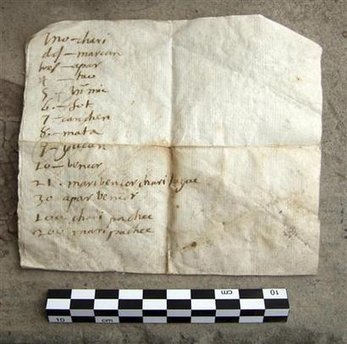 He said it could also be the written version of a language colonial-era Spaniards referred to in historical writings as pescadora, for the fishermen on Peru's northern coast who spoke it.
So far no record of the pescadora language has been found.
The letter, buried in the ruins of the Magdalena de Cao Viejo church at the El Brujo Archaeological Complex in northern Peru, was discovered in 2008.
But Quilter said archaeologists decided to keep their discovery secret until the research showing evidence of the lost language was published this month in the journal American Anthropologist.
"I think a lot of people don't realise how many languages were spoken in pre-contact times," Quilter said. "Linguistically, the relationship between the Spanish conquistadors and the indigenous was very complex."
Pull a buck from your wallet now and prepare to be amazed.
 The question seems simple, but the answer is quite complex. Since 1973, the dollar bill has had no value tied to it. You cannot trade in a dollar to the government for gold, silver, or any other commodity. The value of the nation's currency is related to the decree by the government that a dollar is legal tender for all debts. This means if someone attempts to pay a debt using dollars, the person being paid must accept the money or the law no longer recognizes the debt. This is important enough that the phrase is printed on every bill the government creates.
 Many people believe they can see a tiny owl (some say it is a spider) next to the large "1" on the upper right of the bill. If you look at the shield shape that surrounds that "1," the tiny owl rests on the top left corner.
 The letters are Roman numerals for 1776. M is 1,000, D is 500, CC is 200, L is 50, XX is 20, VI is 6. Add the numerals on the pyramid together and you get the year 1776, when the Declaration of Independence was signed, and when the Novus Ordo Seclorum began.
 Maroni pledged measures to improve the prime minister's security.
 Jesse Ventura, who was the governor of Minnesota and an ex-wrestler “The Bobby”, will make an appearance on the TV show which is also called as the “documentary thriller” with the title name “Conspiracy Theory with Jesse Ventura”. It will make its start from Tru TV network that believes in the slogan “No reality. Actuality”. The TV network makes such investigative thrilling and “revealing” documentaries in most of his programs and shows. “Conspiracy theory with Jesse Ventura” is based upon the investigative probes by
  Ventura in different under-the-cover projects and activities. He is presented as an open-minded investigator who does not operate with a bias towards any activity and gives his conspiracy theory to the public. If someone does not believe in the theory, “MythBusters” is the right forum for nonbelieving faction of people. Tonight’s show covers a new conspiracy theory regarding HAARP project.
 financed by the Department of Defense. There is a “denying spokesman” assigned by the department to “deny” any allegation. He seems “too ready” to deny any fact. The HAARP project is itself portrayed by these authorities as “so-called research project”. They depict the project as a “dormant weapon” lying idle causing no harm to anyone for the time being. But some people have the view that show exaggerates to add spice of thrill that is required by the network. But Jesse is of the view that it is not the case and the reality is often blurred due to lack of concrete evidence. He told that lack of concrete evidence does not mean that something is not being done.


 Nobody was injured when the fragments from shells fired by an anti-submarine ship in the Gulf of Finland fell on houses in the village of Zelyonaya Roshcha, close to the border with Finland, regional military prosecutor Igor Lebedev said. An investigation has begun, Lebedev said.
 The adviser will have the most comprehensive mandate granted to such an official to date and will probably be a member of the National Security Council but will report to the national security adviser as well as the senior White House economic adviser, said the sources, who spoke on the condition of anonymity because the deliberations are not final.
 Obama was briefed a week ago and signed off on the creation of the position, the sources said. But as of Friday, discussions were continuing as to what rank and title the adviser would have. The idea is to name someone who can "pick up the phone and contact the president directly, if need be," an administration official said, speaking on the condition of anonymity.
 The report suggests that although it is a key government responsibility to help secure private-sector networks, regulation should be the last resort, the sources said. The report touts the concept of public-private partnerships to protect nongovernmental systems. It discusses the need to provide incentives for greater data sharing and risk management, and to use the procurement process to drive greater security, they said.
 In theory the celebration is being kept hush-hush by the Secret Intelligence Service. But details are beginning to leak out from its fortress-like headquarters in London.
 MI6 has taken various steps in recent years aimed at demystifying the profession and becoming more approachable.
 The three pop-up adverts appealed to university graduates, young professionals who were bored with their jobs and even those who sought a place in global history.


