
Spassky Cave Church in Russia
13 years ago


Not so fast, doubting Thomas. The video was followed up by a rather official-sounding backer: the  Ontario Science Center, an agency of the Canadian government. A news release was issued:
"Amateur video depicting what could be one of the most elusive legendary creatures, the unicorn, has been captured on film by a Toronto resident. ... The Science Centre is reviewing the footage frame-by-frame to determine whether Hickey-Jones' claim is legitimate."
The center set up an emergency unicorn hotline for more information and sightings.
Could it be true? Could a unicorn exist?...
In a phone call yesterday to the center's media office, the spokeswoman predicted a new unicorn would be sighted sometime in November. Oh really? They're predicting their sightings now?The group just happens to have an new exhibition to promote "Mythic Creatures: Dragons, Unicorns & Mermaids" and, well, the unicorn sighting may have something to do with that, the spokeswoman conceded.
Way to ruin a dream, Ontario Science Center.
 Amateur video depicting what could be one of the most elusive legendary creatures, the unicorn, has been captured on film by a Toronto resident. The video in question, shot by a local birdwatcher, Peter Hickey-Jones, shows what appears to be a white horse with a single horn on its head emerging from the trees in the Don Valley wetland.
 "I was trying to film a pileated woodpecker when I saw what looked like a bright white horse in the distance. When I got a little closer, I noticed the horn on its head. I'm not one to jump to conclusions but I'm certain beyond the shadow of a doubt that what I saw was a unicorn. I'm  just glad I got it on film."
Hickey-Jones brought the footage to the Ontario Science Centre to be analyzed by experts. The Science Centre is reviewing the footage frame-by-frame to determine whether Hickey-Jones' claim is legitimate. With closer examination, Science Centre staff is hoping to establish whether or not a genuine unicorn sighting has occurred.
WASHINGTON – A "hidden" language spoken by only about 1,000 people has been discovered in the remote northeast corner of India by researchers who at first thought they were documenting a dialect of the Aka culture, a tribal community in the foothills of the Himalayas.
They found an entirely different vocabulary and linguistic structure.
Even the speakers of the tongue, called Koro, did not realize they had a distinct language, linguist K. David Harrison said Tuesday.
Culturally, the Koro speakers are part of the Aka community in India's Arunachal Pradesh state, and Harrison, associate professor of linguistics at Swarthmore College, said both groups merely considered Koro a dialect of the Aka language.
But researchers studying the groups found they used different words for body parts, numbers and other concepts, establishing Koro as a separate language, Harrison said.
"Koro is quite distinct from the Aka language," said Gregory Anderson, director of the Living Tongues Institute for Endangered Languages. "When we went there we were told it was a dialect of Aka, but it is a distant sister language."
 People of the Aka culture live in small villages near the borders of China, Tibet and Burma (also known as Myanmar). They practice subsistence hunting, farming and gathering firewood in the forest and tend to wear ornate clothing of hand-woven cloth, favoring red garments. Their languages are not well known, though they were first noted in the 19th century.
The region where they live in the foothills of the Himalaya Mountains requires a special permit to enter. There, the researchers crossed a mountain river on a bamboo raft and climbed steep hillsides to to reach the remote villages, going door-to-door among the bamboo houses that sit on stilts.
Harrison and Anderson spoke at a news conference organized by the National Geographic Society, which supported their work.
The northeast corner of India is known as a hotspot of language diversity and researchers were documenting some of the unwritten tongues when they came across Koro in research started in 2008.
The timing of their discovery was important.
"We were finding something that was making its exit, was on its way out. And if we had waited 10 years to make the trip, we might not have come across close to the number of speakers we found," said Anderson.
Previously undocumented languages are "noticed from time to time" Harrison said, so such a discovery is not rare. But at the same time linguists estimate that a language "dies" about every two weeks with the loss of its last speakers.
Counting Koro there are 6,910 documented languages in the world, Harrison said. But he added that is really just a best estimate that can change regularly.
Many languages around the world are considered endangered, including Koro, he explained, because younger people tend to shift to the more dominant language in a region.
Unusually, Koro has been maintained within the Aka community, the researchers said, even though there is intermarriage and the groups share villages, traditions, festivals and food. In addition to the estimated 800 to 1,200 Koro speakers, the West Kameng and East Kameng districts of Arunachal Pradesh contain 4,000 to 6,000 Aka speakers.
The Koro speakers "consider themselves to be Aka tribally, though linguistically they are Koro. It's an unusual condition, such arrangement doesn't usually allow for maintenance of the minor language," Anderson said.
The threat, however, is from the spread of Hindi, a dominant language in India, and many youngsters go to boarding schools where they learn Hindi or English.
The researchers said they hope to figure out how the Koro language managed to survive within the Aka community.
They said Koro is a member of the Tibeto-Burman language family, a group of some 400 languages that includes Tibetan and Burmese. While Koro differs from Aka, it does share some things with another language, Tani, which is spoken farther to the east.
The research was started in 2008 to document two little known languages, Aka and Miji, and the third language, Koro, was discovered in that process.
"We didn't have to get far on our word list to realize it was extremely different in every possible way," Harrison said.
They said Koro's inventory of sounds was completely different, and so was the way sounds combine to form words. Words also are built differently in Koro, as are sentences.
The Aka word for "mountain" is "phu," while the Koro word is "nggo." Aka speakers call a pig a "vo" while to Koro speakers, a pig is a "lele."
"Koro could hardly sound more different from Aka," reported Harrison, author of a new book "The Last Speakers," about vanishing languages. Joining the two was linguist Ganesh Murmu of Ranchi University in India.
The researchers detail Koro in a scientific paper to be published in the journal Indian Linguistics.
LIMA (Reuters) – Archaeologists say scrawl on the back of a letter recovered from a 17th century dig site reveals a previously unknown language spoken by indigenous peoples in northern Peru.
 A team of international archaeologists found the letter under a pile of adobe bricks in a collapsed church complex near Trujillo, 347 miles (560 km) north of Lima. The complex had been inhabited by Dominican friars for two centuries.
"Our investigations determined that this piece of paper records a number system in a language that has been lost for hundreds of years," Jeffrey Quilter, an archaeologist at Harvard's Peabody Museum of Archaeology and Ethnology, told Reuters.
A photograph of the letter recently released by archaeologists shows a column of numbers written in Spanish and translated into a language that scholars say is now extinct.
"We discovered a language no one has seen or heard since the 16th or 17th century," Quilter said, adding that the language appears to have been influenced by Quechua, an ancient tongue still spoken by millions of people across the Andes.
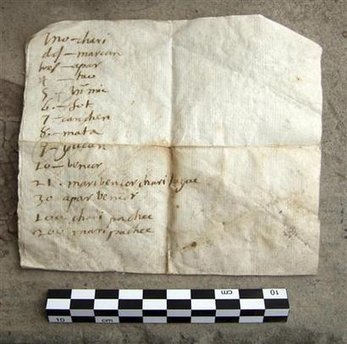 He said it could also be the written version of a language colonial-era Spaniards referred to in historical writings as pescadora, for the fishermen on Peru's northern coast who spoke it.
So far no record of the pescadora language has been found.
The letter, buried in the ruins of the Magdalena de Cao Viejo church at the El Brujo Archaeological Complex in northern Peru, was discovered in 2008.
But Quilter said archaeologists decided to keep their discovery secret until the research showing evidence of the lost language was published this month in the journal American Anthropologist.
"I think a lot of people don't realise how many languages were spoken in pre-contact times," Quilter said. "Linguistically, the relationship between the Spanish conquistadors and the indigenous was very complex."
 Ten royal members of King Tut's family, mummified during the the late 18th century BC, have also been exhumed to study lineage, as well as possible diseases to which the royal family succumbed, and whether they were inherited or opportunistic. Using genetic fingerprinting, the scientists confirmed the identity of Tut's grandmother and father, but not the specific relationships of the other eight members.
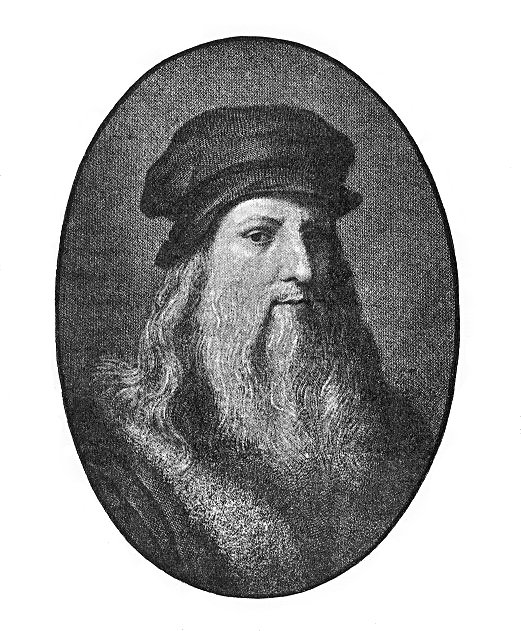 The team from Italy's National Committee for Cultural Heritage, a leading association of scientists and art historians, wants to exhume the remains of the great painter to be able to throw new light on his most famous work, reports The Times.
Laptops and Blackberry mobile phones have been blessed in a church ceremony in the City of London. Canon David Parrott blessed the gadgets at the St Lawrence Jewry church in an updated version of a traditional "Plough Monday" back-to-work ceremony.
A number of parishioners held their mobile phones up as Rev Parrott recited a prayer.
He said: "It's the technology that is our daily working tool and it's a technology we should bless."
The 17th Century building is the official church of the City of London Corporation.
On Monday Canon Parrott placed a number of laptops and phones on its altar.
He said it would remind the capital's busy office workers that God's grace could reach them in many ways.
Canon Parrott then recited a blessing over the parishioners and their electronic devices.
He said he hoped the ceremony had made worship "lively and relevant to the people who work nearby, in the financial district".
The traditional Plough Monday ceremony blessed a symbolic farming implement which had been dragged to the church's door.
Canon Parrott updated that ceremony, as he said it didn't have much relevance for his church, which was "nowhere near a field, in the middle of London".
Canon Parrott, who took up the post seven months ago, described the ceremony as "a fresh idea for a fresh post".


