
Faced with pressure from the global battle against piracy, the world's largest torrent site has announced that switching to a new way of downloading on 29 February, more accurately file sharing movies, music, games, software ...
Official blog "Pirates":
In following with our decision to skip .torrent-files in the nearby future one of the biggest steps will come on the 29th of February. We will stop serving .torrent-files for all torrents that has has more than 10 peers from this date.
The so-called torrent files, will replace "magnet links". This basically means that the contents or files from now on, will be downloaded from a computer other users, and not from the website Pirate Bay.
It is expected that this will primarily mean slower downloading torrent, considering that in the beginning small number of people will share the magnet links.
Let us remind, one of the biggest torrent search engines BTJunkie, he decided to stop working last week after the U.S. Justice closed the file sharing site Megaupload. Swedish Justice upheld prison sentences against the founders of the Pirate Bay site.
Advertisement called "The Bark Side" shows a group of dogs whose barking creates the famous melody from the cult film "Star Wars".
Although the site "Megaupload" is recently shut down its advertising is still alive. Stars, such as P. Daddy, Kanye West and Mary J. Blige gave a contribution to this advertisement.
The couple who ran a small store in Toronto has made this commercial in which he composed a great animation with music. Mentioned video shows what happens to the books at night.
Actor Matthew Broderick is back again as Ferris Bueller, character from the movie "Ferris Bueller's Clear Day" (1986). In the commercial for the Honda he pretends to be ill to at least one day do what he want to do.
Coca-Cola Company in association with the singer by the name of Si Lemhaf, recorded the official anthem of Tunisia's national football team.
Wikipedia will go offline in opposition to the Stop Online Piracy Act (SOPA), a bill that would allow the U.S. government to cut off funding sources to foreign websites accused of piracy by rights holders. PIPA, the Protect IP Act in the Senate, and SOPA, the Stop Online Piracy Act, have been presented as a way to protect movie studios, record labels and others. Supporters range from the Country Music Association to the U.S. Chamber of Commerce.
Websites found to offer pirated content, along with the services that they use, could be hidden from US internet users by being delisted on search engines and potentially on DNS servers themselves.
The Internet giants say the bills could require your Internet provider to block websites that are involved in digital file sharing. And search engines such as Google, Yahoo and Bing could be stopped from linking to them -- antithetical, they say, to the ideal of an open Internet.
The whole explanation you can find on Wikipedia, or just click here.
Hidden in a Hubble Space Telescope photo released earlier this year is a small smudge of light that European astronomers now calculate is a galaxy from 13.1 billion years ago. That's a time when the universe was very young, just shy of 600 million years old. That would make it the earliest and most distant galaxy seen so far.
By now the galaxy is so ancient it probably doesn't exist in its earlier form and has already merged into bigger neighbors, said Matthew Lehnert of the Paris Observatory, lead author of the study published online Wednesday in the journal Nature.
"We're looking at the universe when it was a 20th of its current age," said California Institute of Technology astronomy professor Richard Ellis, who wasn't part of the discovery team. "In human terms, we're looking at a 4-year-old boy in the life span of an adult."
While Ellis finds the basis for the study "pretty good," there have been other claims about the age of distant space objects that have not held up to scrutiny. And some experts have questions about this one. But even the skeptics praised the study as important and interesting.
The European astronomers calculated the age after 16 hours of observations from a telescope in Chile that looked at light signatures of cooling hydrogen gas.
Earlier this year, astronomers had made a general estimate of 600 to 800 million years after the Big Bang for the most distant fuzzy points of light in the Hubble photograph, which was presented at an astronomy meeting back in January.
In the new study, researchers focused on a single galaxy in their analysis of hydrogen's light signature, further pinpointing the age. Garth Illingworth of the University of California, Santa Cruz, who was the scientist behind the Hubble image, said it provides confirmation for the age using a different method, something he called amazing "for such faint objects."
The new galaxy doesn't have a name — just a series of letters and numbers. So Lehnert said he and colleagues have called it "the high red-shift blob. "Because it takes so long for the light to travel such a vast time and distance, astronomers are seeing what the galaxy looked like 13.1 billion years ago at a time when it was quite young — maybe even as young as 100 million years old — Lehnert said. It has very little of the carbon or metal that we see in more mature stars and is full of young, blue massive stars, he said.
What's most interesting to astronomers is that this finding fits with theories about when the first stars and galaxies were born. This galaxy would have formed not too soon after them.
"We're looking almost to the edge, almost within 100 million years of seeing the very first objects," Ellis said. "One hundred million years to a human seems an awful long time, but in astronomical time periods, that's nothing compared to the life of the stars."
"How can it be ordinary? There is something going on."Despite clear skies, it was not easy to make out the tiny object shimmering overhead."You really have to look up to see it," said one witness, who gave only his first name, Rico. "It's a little crazy. I guess that's why they call it an unidentified flying object because they don't know what it is."Not long after the first sightings, messages began appearing on Twitter linking to a month-old press release announcing the publication of a book by a retired NORAD officer predicting that UFOs would buzz the earth's major cities on Oct. 13.The Federal Aviation Administration said it received several calls to its operations center but after reviewing radar data, the agency could not find anything out of the ordinary."We re-ran radar to see if there was anything there that we can't account for but there is nothing in the area," said spokesman Jim Peters. "There was some helicopter traffic over the river at that time and we checked with LaGuardia Tower. And they said they had nothing going low at that time.""Nothing that we can account for would prompt this kind of response," he said.Peters said if it was a weather balloon or any kind of organized balloon release, authorities should have been notified in advance. Police officials said they had received no notification.
Oh, to have a "dislike" button on Facebook, to be able to tell your friends what you really think of their movie reviews or their complaints about the job when you know you work much harder than they do.
There is such a button being offered around on Facebook, but it is not the real thing. Not only is it not the real thing — it's a rogue application, and if you give it permission to access your profile, it will post spam messages from your account. It will ask you to complete an online survey, which generates money for the wisenheimers who dreamed this scam up.
You may see postings on your Facebook wall purportedly from your friends who may have bitten on this one. And who can blame them? The social networking site lets users click on a "like"

button with a "thumbs up" icon, or post comments about comments, but still, to date, there is no one-click way to transmit the sentiment: "No, I don't like this!"
Graham Cluley, a senior technology consultant with software security firm Sophos, based in Britain, sounded the alert on his company's blog, noting that "it's the latest survey scam spreading virally across Facebook, using the tried-and-tested formula used in the past by other viral scams." Past successful scams include such lures as Justin Bieber flirting, the world's biggest and scariest snake and the "world's worst McDonald's customer."

You might see messages posted on your wall saying, "Get the official DISLIKE button NOW!" or "I just got the Dislike button, so now I can dislike all of your dumb posts lol!!." Ignore, ignore, ignore and do not give the application permission to run, says Cluley.
"If you do give the app permission to run, it silently updates your Facebook status to promote the link that tricked you in the first place, thus spreading the message virally to your Facebook friends and online contacts," he wrote.
"But you still haven't at this point been given a 'Dislike' Facebook button, and the rogue application requires you to complete an online survey." The survey will help make money for the scammers, and point you to a Firefox browser add-on for a "Dislike" button made by FaceMod as a Facebook add-on.
FaceMod, Cluley says, is not connected with the scam — "their browser add-on is simply being used as bait." Cluley says that if you are desperate to try the actual Dislike button (which his firm is in no way endorsing), be sure to get it only through the Firefox Add-ons Web page.
Part of the reason an offer for a "dislike" button is so alluring is because some Facebook users want one. More than 3 million of them have joined a group on Facebook to say so.
In a July interview with ABC, Facebook CEO Mark Zuckerberg said company officials would "definitely think about" adding a "Dislike" button. But like it or "dislike" it, it hasn't happened yet.
The world’s largest tidal turbine was recently unveiled on August 11th 2010 at Invergordon, Scotland, weighing 130 tons, 74ft (22.6m) tall, with two 60ft (18.3m) diameter rotors and generating 1MW on both tidal ebb and flow. The Atlantis Resources AK1000 can supply power to 1000 homes, and is to be installed at the European Marine Energy Centre in the Orkney Islands, and has taken more than ten years to develop.
Atlantis Resources' chief executive Tim Cornelius explained that, " The turbines turn at six to eight revolutions per minute, so are incredibly slow turning and will have zero impact on the surrounding environment." Theoretically, the turbine rotors should not harm marine animals.
So what is Tidal Current Power?
Tidal current technology is a form of hydropower and harnesses the energy in tides and converts it into usable power.
Tidal current power is different from wave power. Wave power harnesses power of the waves while Tidal Current technology extracts energy from the high tide bulge created by the gravitational pull of the Moon and Sun moving horizontally around the Earth’s surface.
As per the Atlantis, Sea water, which is 832 times denser than air, gives a 5 knot ocean current more kinetic energy than a 350 km/h wind; therefore ocean currents have a very high energy density. Hence a smaller device is required to harness tidal current energy than to harness wind energy.
Tidal Power and Tidal current power differ in that, Tidal power requires the building of barrages to manage and direct the flow of the current etc… the civil construction cost and impact on the environment is much higher in the tidal power barrage systems.
Tidal Power facts:
- The first large scale tidal power system the Rance Tidal Power station in Brittany, France, started functioning in 1966! It is still the largest tidal power station based on installed capacity.
- Tidal power stations were first developed and tested in the 1970’s; they harness the water masses that periodically flow into sea bays and drive conventional hydro turbines when the tide goes out. The disadvantage of this technology is that they require large barrages in the sea.
- Unless taken to extremes, Tidal Current power system does not require blocking of any waterways, and hence does not have the adverse environmental effects associated with Tidal Barrages.
- Tidal current energy takes the kinetic energy available in currents and converts it into renewable electricity.
- As oceans cover over 70% of Earth’s surface, ocean energy (including wave power, tidal current power and ocean thermal energy conversion) represents a vast source of energy, estimated at between 2,000 and 4,000 TWh per year, enough energy to continuously light between 2 and 4 billion 11W low-energy light bulbs.
- USA and UK could produce 15% of power they need from the Ocean itself.
On the whole the project sounds and looks really good and it has been working in Australia. Will wait to see how it works out in Orkney, Scotland.
Thousands of people flocked to an exhibition in Japan on Sunday to see a capsule from the Hayabusa space probe which was hoped to have brought asteroid dust to Earth.
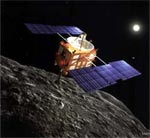
Some 1,800 people were queuing in Tokyo to see the heat-proof pod, which had travelled in space with the unmanned craft for seven years, even before the exhibition opened in the morning, a Japan Aerospace Exploration Agency (JAXA) spokesman said.
More than 7,000 had visited the first public showing of the capsule by early evening, he said, adding that the space agency expects as many as 50,000 people during the five-day exhibition.
The capsule, which journeyed billions of kilometres (miles), was fired back to Earth in June.
Technical problems had plagued the Hayabusa, which at one stage spun out of control and lost contact with JAXA for seven weeks, delaying the mission for three years until the asteroid and Earth re-aligned.
When it finally latched onto the potato-shaped Itokawa asteroid, a pellet-firing system designed to stir up dust malfunctioned, leaving it unclear how much material the probe was able to gather.
Scientists hope any dust samples from the ancient asteroid in the capsule could help reveal secrets about the origins of the solar system.
The space agency has said it found "minute particles" of what it hopes is asteroid dust in the capsule, but it is expected to take months to get the final results of the analysis.
The Hayabusa project has generated great excitement in Japan.
"I was so impressed that such a small thing came back to Japan after a seven-year space journey," said one of the visitors. "It is just amazing."
(Reuters) – A lake in Argentina's remote, inhospitable northwest may offer clues on how life got started on Earth and how it could survive on other planets, scientists say. Researchers have found millions of "super" bacteria thriving inside the oxygen-starved Lake Diamante, in the center of a giant volcanic crater located over 15,400 feet above sea level.
The bacteria's habitat is similar to primitive earth, before living and breathing organisms began wrapping a protective atmosphere of oxygen around the planet.
The conditions -- which include high arsenic and alkaline levels -- could also shed light on life beyond Earth.
"This is of great scientific interest as a window to look to our past and also for a science called astrobiology, the study of life on other planets," said Maria Eugenia Farias, part of the team that discovered the life-forms in Lake Diamante earlier this year.
If bacteria can survive here, the theory goes, it could also survive somewhere like Mars.
So-called "extremophiles" have been found in other parts of the world -- and they can have significant commercial value. Bacteria that break down lipids are used in detergents for example.
But Farias said these bacteria, called "polyextremophiles" are exceptional because they flourish in the harshest of circumstances.
"What we have here is a series of extreme conditions all in one place. And this is what makes this place unique in the world," said Farias, a microbiologist at the National Scientific and Technical Research Council in Tucuman province.
The lake sports levels of arsenic 20,000 times higher than the level regarded as safe for drinking water and its temperature is often below freezing. But because the water is so salty -- five times saltier than sea water -- ice never forms.
The bacteria's DNA mutates to survive the ultra-violet radiation and low oxygen levels found at such high altitudes, which could make it of interest to the pharmaceuticals industry, Farias said. It could also have future commercial applications in products such as sunscreens, she added.
Farias and her team are looking for Argentine funding to produce a metagenome of the bacteria, an advanced study which provides a DNA sequence of the entire microbe colony.
This would enable her crew to study the bacteria in Argentina and help ensure that the South American country keeps hold of potentially lucrative patents for new antioxidants or enzymes that could be derived from the bacteria.
Apple Inc. is getting exclusive access to an exotic metallic material that could provide it with shiny, super-tough computer and phone casings.Liquidmetal Technologies Inc., a Caltech spinoff in Rancho Santa Margarita, Calif., filed a regulatory notice recently that it's granted Apple a perpetual, exclusive license to use its technology in consumer electronics. Liquidmetal retains the rights for other applications.
Apple isn't saying anything about the deal, and it's far from certain that the material will ever make it into its products. Though it matches the sleek Apple aesthetic, it's prohibitively expensive.
The name "Liquidmetal" brings to mind the silvery, shapeshifting villain of the "Terminator 2" movie, but the company's products are somewhat less dramatic. It mixes molten metal alloys in such a way that, when they cool, the structure of the material is more similar to glass than metal.
The materials aren't translucent, but they have other interesting benefits.
One is that they can be cast so precisely that they need little or no machining afterward. Regular metals shrink as they cool, which means they lose contact with the die and need polishing for a smoothness.
"Metallic glass" can also be very hard. Hard materials are often brittle, like glass, and that was a problem with early alloys. Liquidmetal CEO Thomas Steipp said the company has figured out how to make tougher variants, much like Pyrex glass is tougher than regular glass.
Apple is big on using metal in its designs -- virtually every Mac is clad in aluminum, except for the cheapest MacBook. It's even started making the bodies for its laptops and Mac mini desktop computers out of single, big chunks of aluminum that it then hollows out. With Liquidmetal, that time-consuming process could conceivably be replaced with casting. Aluminum is also a relatively soft metal, prone to denting, scratching and scuffing.
However, Liquidmetal is still very expensive because of it needs exotic raw materials, including beryllium. Some Liquidmetal alloys contain large amounts of platinum, which costs $1,500 an ounce. The alloys have gone into luxury watches, luxury phones, medical devices and some sporting gear, such as tennis rackets and skis, but they are far from being mass-market materials.
Steipp said he could not say what Apple might use the materials for. Neither company disclosed the value of the deal, but Liquidmetal seems to have gotten a shot in the arm from it. It hasn't filed a financial statement since last year, but Steipp, an experienced technology executive, was appointed five days after the deal was announced.
"I believe there's an opportunity for Liquidmetal to be a catalyst for changing the way that product designers think about building their products. It's that different," Steipp said. "We have to prove that, but certainly from what I've seen as technology executive evaluating the technology before I came in ... we've made a lot of progress over the last eight years."
Check for malware
Spyware, adware and viruses slow your machine. Malware shouldn't be a problem if you use up-to-date security software. Still, scan your machine for viruses and spyware and remove any problems found. If you need security software, visit my site for free programs.Clean your hard drive
A full hard drive slows down your computer. It will take longer to access files. So, clean it up. Windows and programs you install often create temporary and setup files. Use Disk Cleanup to remove them. Access Disk Cleanup by clicking Start, then All Programs, Accessories, System Tools and Disk Cleanup.
After the program scans your drive, you'll see a list of file categories. Clear Temporary files, Temporary Internet Files and the Recycle Bin. Make your selections and click OK. It may take a few minutes to delete the files.
Remove unwanted programs
You probably have plenty of programs that you no longer use. They're probably slowing you down.
Remove unwanted programs via Windows' Control Panel. Click Start, then Control Panel. In Windows Vista, double-click Programs and Features. In Windows XP, double-click Add or Remove Programs. Select a program to uninstall and click Uninstall in Vista. In XP, click Change/Remove. Follow the prompts.
Clean restore points
System Restore lets you roll back your Windows settings to an earlier time. It's a handy feature. But too many restore points can slow down certain processes. Clearing old restore points can speed up your PC.Click Start, then All Programs, Accessories, System Tools and System Restore. In XP, click System Restore Settings. Select "Turn off System Restore." Click Apply and then Yes to confirm. Restart System Restore. When prompted, click Yes to re-enable System Restore.
In Vista, click "open System Protection." Deselect your Drive and confirm your choice. Click OK. Close and reopen System Restore. Click "open System Protection." Click OK. Close System Restore. Reboot your machine to create a new restore point.
Defragment your drive
Windows often splits files, storing parts in separate areas of the hard drive. This file fragmentation makes your computer work harder to access files. Overcome this problem by defragmenting the drive. Data is rearranged for more efficient access. Read and write times will improve.
Click Start, then All Programs, Accessories, System Tools and Disk Defragmenter. Select your C:
drive and click Analyze. Then, click Defragment. Don't use your computer or leave programs running while using Disk Defragmenter. It will cause errors.Check for errors
Errors may also be slowing your hard drive down. Error Checking finds and fixes them for you. It also checks the integrity of your files.
Open My Computer and right-click the C: drive. Select Properties. Click Check Now in the Error-checking section of the Tools tab. Select "Scan for and attempt recovery of bad sectors." Click Start. Allow Windows to fix any bad sectors that are found.
Switch to OpenDNS
You can speed up Web browsing by using a different DNS server. A DNS server helps your browser locate pages online. Your DNS requests may be going through several, distant servers. Instead, use OpenDNS.

OpenDNS sends requests to the closest server. Once you sign up for an account, you have to make a few simple changes on your machine. The service's site walks you through the process. Clean your hardware
The outside of your computer needs to be cleaned, too. Your keyboard may be filthy, and your monitor may be covered with dust. The fan vents are magnets for dust, pet hair and other things that don't belong inside your computer.
Start by wiping down your monitor. Turn it off and unplug it from the power socket. Use a soft, lint-free cloth that is slightly damp. Avoid paper towels and window cleaners; they can scratch and cloud the display.
If you have a standard, no-frills keyboard, run it through the dishwasher. Allow it to dry completely before using. Otherwise, unplug the keyboard and wipe it down with a damp cloth. Canned air can remove debris between keys. Likewise, use canned air to clear your computer's vents.
Eleven solar thermal farms have been proposed for Southern California and are going through the permitting process with the California Energy Commission and with the U.S. Bureau of Land Management if on federal land. The 11 farms are among the biggest of the almost 50 renewable energy projects seeking to begin construction in California before the end of the year so they can seek federal stimulus funds.
The company proposed a 2,000-acre solar farm, named Beacon, on fallow agricultural land on the edge of California's Mojave Desert. The site has the great desert sun but is on degraded land near a freeway, an auto test track and old buildings.
The site "is exactly where solar should be," says David Myers, head of conservation group Wildlands Conservancy.But two years later, NextEra still awaits permission to begin construction from the California Energy Commission, which grants permits on such projects after environmental reviews. Time is running short, not only for NextEra but for several dozen green-energy projects in California. Ground must be broken on them before year's end to get federal stimulus funds worth 30% of the projects' cost.
The deadline — and the push for green energy by President Obama and California Gov. Arnold Schwarzenegger— has inspired unprecedented coordination among regulators and environmentalists who want green energy but not rampant destruction of wilderness. If they succeed in siting so many large solar projects quickly, California may set a precedent for how other states resolve concerns over land use vs. the benefits of green energy.
"It's a scene that's being played out all over the country," says Benjamin Kelahan, senior vice president for energy of the Saint Consulting Group. But California, he says, is "a hotbed of activity."
Yet the sheer number and size of the California projects, especially a dozen huge solar farms unlike anything regulators have reviewed in 20 years, is stressing agencies and stakeholders alike. No other state has so many huge solar projects in the pipeline. Billions of dollars in stimulus funds ride on whether the permitting process can be sped up without sacrificing California's stringent environmental standards.
No corners are being cut, regulators say. But some environmentalists fear that the tight deadlines will lead to projects that could've been better with more time. And companies say that some projects, like NextEra's, have suffered delays born of inefficient permitting.
"These are large projects at a scale we've never seen before on a time schedule that's never been done before," says Kimberley Delfino, California program director for the environmental group Defenders of Wildlife. "This is not going to be an easy thing to do."
Promise of power, jobs
If all are built, the 49 projects seeking stimulus funding would generate 11,000 megawatts of electricity a year. That's enough to supply 7 million California homes and give California utilities a big boost in meeting mandates to get 33% of their energy from renewable sources by 2020.
The projects also would drive 10,000 construction jobs, 2,200 operational jobs and up to $30 billion in investment, including up to $10 billion in federal stimulus dollars, says Michael Picker, Schwarzenegger's renewable-energy adviser.
Twenty-two of the 49 projects account for 83% of the power. Some projects fall under the permitting process of counties. But the vast majority of the large solar projects fall under the review of the California Energy Commission and, if the projects are on federal land, the U.S. Bureau of Land Management.
California and federal regulators are working under conditions far from the norm.
Typically, the California Energy Commission rules on seven power plants a year, most often 20- to 40-acre natural-gas plants. This year, it has almost three dozen projects to review, including 11 large solar farms, several of which will each cover 10 square miles of land. Some projects that would normally take two years to review are seeking eight- to nine-month turnarounds, says Tom Pogacnik, a deputy state director for the Bureau of Land Management.
Never before have the bureau and the commission worked so closely to coordinate and expedite project reviews, says Terrence O'Brien, commission deputy director. He's dubbed a fourth-floor conference room a "war room," where staffers meet weekly to set priorities.
In November, commission staffer Christopher Meyer noted that the staff was already "sort of at a breaking point" with the workload, a transcript of a hearing on one of the solar farms says.
More people have since been hired. At the commission, 110 employees work on siting projects, up 25% since the fall. And while other state workers face furloughs on some Fridays, a consequence of California's budget woes, "We're working," O'Brien says.
The agencies are "tearing their hair out," says Peter Weiner, who, at law firm Paul Hastings, represents solar developers.
Moving too fast or too slow?
Whether the permitting process is fast or slow, complete or subpar depends on who's talking — and when.
In January, NextEra thought its chances were "grim" to get the $1 billion Beacon project through the process in time to qualify for $300 million in federal cash grants that are given instead of tax credits as part of the stimulus program, says Matthew Handel, NextEra vice president.
At a January hearing before the California Energy Commission, NextEra unfurled a string of complaints about the process. The Beacon site had to have a plan to relocate desert tortoises, although the site "has no desert tortoises," NextEra's Scott Busa said. The company had to redo a plan five times to monitor ravens that prey on baby tortoises, although the solar fields would draw fewer ravens than the sheep that currently graze and sometimes die on the land, providing a "raven buffet," Busa said.
He also said state regulators gave NextEra a 382-day plan to offset any effect on Native American cultural resources on the site, when the company didn't have 382 days before it had to break ground to get stimulus funding.Given that the site was considered almost "perfect" for solar, Busa said, "I wonder why we're here two years later?"
After the hearing, the state reduced some demands. For instance, it cut the 382-day plan to 180 days by reducing how much land needed to be surveyed, Busa says. "They've recognized they're under time constraints," he says.
NextEra, a subsidiary of the Florida-based FPL Group energy company, is now optimistic the project will make the Dec. 31 deadline.
The commission's O'Brien says he also wishes that Beacon's review had gone faster. But he says part of the blame rests with NextEra, which at first proposed using fresh groundwater despite commission opposition. "It wasn't a perfect project, and it took time to resolve the issues," O'Brien says.
Home to threatened species
NextEra is proposing one of 11 large solar thermal farms. The farms concentrate the sun's power on mirrors to produce heat used to generate electricity. They'll cover thousands of acres, many of them largely untouched desert. The region has the most intense sun in North America, but it's also home to threatened species, such as the desert tortoise, and rare plants.
Environmentalists, who're largely supportive of solar, still worry that environmental reviews will be rushed.
"We need to proceed with caution, and what the stimulus deadline has done is remove our ability to do that," says Gloria Smith, an attorney for the Sierra Club in San Francisco.
Last week, the Sierra Club faced a two-day deadline to respond to information presented at an all-day hearing on one solar farm. After it complained, the response time was set at eight business days. Typically, it'd be weeks, Smith says.
Some agency reports also lack information they'd normally have, says Joshua Basofin, California representative for Defenders of Wildlife. This month, the commission and the Bureau of Land Management filed their joint environmental review on the 6,500-acre Blythe Solar Power Project. At the filing, numerous issues were unresolved, including relocating desert tortoises and offsetting damage to burrowing owl habitat and Native American cultural resources.
"We're very concerned that there hasn't been comprehensive environmental analysis for some of these projects," Basofin says.
The commission's O'Brien says environmental reviews will be complete. If first reports lack data, the agencies will file supplements, he says.
Several of the projects have changed to reduce their effects on the environment. The Ivanpah solar farm, at 3,500 acres, shrank 12% to lessen damage to desert tortoise and rare plant habitat. The Imperial Valley Solar farm, at 6,000-acres, is 16% smaller than originally proposed to avoid an area especially rich in Native American resources around land that was once an ancient lake.
Next few months are critical
Project developers are hopeful that the deadline for 30% cash grants will be extended, as Sen. Dianne Feinstein, D-Calif., has proposed in legislation. "But nobody wants to count on an extension," says Sean Gallagher, vice president of Tessera Solar, which has two projects. The stimulus funds "are a critical part of the financing," Gallagher adds.
The next few months are also critical. Companies need permits by fall to have time to finalize financing and transmission plans. Picker, of the governor's office, expects up to 75% of the larger projects will get permits in time.
While some environmentalists say those may not be as well-designed as they could be, leading groups also recognize that land conservation isn't the only factor to consider. Global warming will degrade even pristine land, says environmentalist Delfino. Greener energy is a way to fight back, leading her to conclude that some habitat destruction is worth a bigger "long-term" gain.
"But we cannot have the cure be worse than the disease," Delfino says.
Space is the next frontier in adventure travel, suggests a survey analysis, with sub-orbital tourism perhaps embracing the modern-day jet set this year.In the current Acta Astronautica journal, Véronique Ziliotto of Holland's European Space Research and Technology Centre, looks at recent polls and industry estimates to reckon the chances of space tourism getting off the ground. Virgin Galactic's SpaceShipTwo effort, in particular, looks to start flights as soon as this year, she notes, and already has about 200 flight reservations.
"In 2003, luxury travel had 20 million customers globally and generated 91 billion in revenue, which represents 20% of tourism revenues worldwide. This large untapped market represents a unique chance for space tourism," Ziliotto writes. Since then, she adds, "(t)hanks to recent technological achievements such as Burt Rutan's SpaceShipOne in 2004, Bigelow's Genesis I in July 2006 and Genesis II in July 2007 and the success of space adventures' flights to the ISS, space tourism is leaving the realm of science-fiction." The Bigelow Genesis I inflatable space station prototype made its 10,000th orbit of Earth in 2008.
A 2006 Futron Corporation poll of millionaires, asking them about their interest in Virgin Galactic sub-orbital space flights, found that "estimated demand for the year 2021 would be over 13,000 passengers, generating revenues in excess of US$600 million." Tickets would be $200,000 the first three years, and then drop to $50,000 thereafter. A second "adventurer's" survey that year found less demand until tickets dropped to $50,000; many of the customers preferred to wait for moon trips, not currently envisioned by space tourism firms.
More recently, one aerospace firm estimated the demand for space flights at 13,000 to 15,000 passengers per year. "In this case, the market would not be limited by demand but by the number of attractive locations for spaceports on Earth that permit a safe integration of spacecrafts in the local air traffic," Ziliotto writes.
"Promises made to public that in some future, ordinary people may experience most of the feelings of professional astronauts by simply booking a seat in a privately operated spaceship, appear today credible to some operators," says France's Christophe Bonnal of the
CNES–Launcher Directorate, in an editorial accompanying the analysis. "The hurdles are nevertheless quite significant in all domains, technical, legal, medical, insurance, and even when solved, the viability of the market will have to be demonstrated. Today, one can say we still have more questions than answers."Legal and regulatory hurdles "are undoubtedly among the most severe constraints today", he adds, particularly outside the USA. A space symposium in France last looked at the demand for space tourism in 2008, he notes, prior to the current severe economic downturn.
"The commercial future of suborbital space travel is deemed promising and the interest in private spaceflight has built up during the last few years," concludes Ziliotto. "Nevertheless, it still faces major challenges and winning the potential customers' confidence about the safety of the flights is not the least one. An accident in the early phases of commercial operation could bring the industry to a halt and jeopardize its future."
Google's decision this week to close its self-censored Internet search service in mainland China was provoking diverse reactions here Thursday."I'm very disappointed about Google's departure as I hoped they would stay," says Professor Stan Li, who runs biometrics and security research at the Chinese Academy of Sciences.

The majority of Chinese Internet users responded more like tour guide Li Wenwen: "I never look at political or sensitive sites," says Li, 20,
China employs an array of censorship tools widely known here as the "Great Firewall." Perhaps the most effective method is the self-censorship that media organizations here, including Google until Monday, accept as the price of doing business.
Google stopped censoring its search results Monday because it said it was the target of hacking attacks originating from China. Google now redirects "Google.cn" traffic to its Hong Kong-based site, which it does not censor. Hong Kong is a Chinese territory that is semiautonomous because of its past as a British colony.
On Thursday, some Google searches produced the same results whether from Beijing or Hong Kong. Among them is "Michael Jackson;" another is "Taiwan," which considers itself separate from China and that China considers its own.Type "Falun Gong" in Chinese into Google's search engine from Beijing, and the Web browser suddenly becomes unresponsive. Make the same search from Hong Kong and you'll get many links to the spiritual movement banned by the Chinese government.
China maintained Thursday that Google is acting on orders from the U.S. government. Ding Yifan, a development researcher affiliated with China's Cabinet, said in the China Daily newspaper that Google's exit "is a deliberate plot," part of "Washington's political games with China."
The State Department has said it was not involved in Google's decision, though Secretary of State Hillary Rodham Clinton championed Internet freedom in a recent speech. Congress has appropriated $35 million for grants to develop technology that helps circumvent Internet censorship.
Li, the professor, says the Chinese government puts too many restrictions on the Internet.
"I think they should reconsider and make some changes, like less restrictions," he says.
Some Chinese use proxy servers to get around censorship. Most just use state-sanctioned search engines.
"Baidu is quicker and more convenient," Li, the tour guide, says of China's largest search engine.
Flowers and tributes have been left by a stream of people outside Google's Beijing headquarters. Taxi driver Tian Liang will not be leaving a bouquet. "There's fierce competition in this area. I think that's why Google leaves China," says Tian, 40. "I don't like the foreign companies who use politics as an excuse for their commercial interests."
The SpaceShipTwo rocket plane is attached between the twin fuselages of its WhiteKnightTwo carrier airplane, as seen from below during Monday's test flight
from California's Mojave Air and Space Port.
The craft, which has been christened the VSS Enterprise, remained firmly attached to its WhiteKnightTwo carrier airplane throughout the nearly three-hour test flight. It will take many months of further tests before SpaceShipTwo actually goes into outer space. Nevertheless, today's outing marks an important milestone along a path that could take paying passengers to the final frontier as early as 2011 or 2012.
The captive-carry flight comes three and a half months after SpaceShipTwo's unveiling in Mojave. The project, backed by British billionaire Richard Branson, builds upon the first-ever private-sector spaceflights, flown five years ago by the SpaceShipOne prototype plane. Both SpaceShipOne and SpaceShipTwo were designed by aerospace guru Burt Rutan.
Today's test was the first in a series aimed at checking the aerodynamics of the rocket plane in a controlled, real-world environment. The configuration for SpaceShipTwo is significantly different from that for SpaceShipOne (which is now hanging in the Smithsonian's National Air and Space Museum) and its WhiteKnightOne mothership. SpaceShipOne was slung right beneath WhiteKnightOne's fuselage, while SpaceShipTwo rides between WhiteKnightTwo's twin fuselages.
Virgin Galactic's spaceflight profile calls for the rocket to be taken up to around 50,000 feet in altitude, where it would be released from the mothership. SpaceShipTwo would then fire up its own rocket engine for the final push to space. But for these initial captive-carry tests, the rocket plane will stay attached to WhiteKnightTwo.
Virgin Galactic's SpaceShipTwo rocket plane takes to the air for a test flight on Monday, firmly connected to its WhiteKnightTwo carrier airplane.
When Rutan and his team are confident that they've tweaked the design to optimize its flightworthiness, they'll move on to the next phase of testing: unpowered glide tests, during which WhiteKnightTwo will release SpaceShipTwo (and its pilot) for a gliding flight back down to the Mojave runway.
That phase will lead to an even more ambitious series of flights, scheduled to start next year, during which SpaceShipTwo will light up its hybrid rocket engine. Eventually those powered test flights will push the plane beyond the sound barrier - and beyond the 100-kilometer (62-mile) altitude mark that serves as the internationally accepted boundary of outer space.
Passenger operations won't begin until a goodly number of test flights have broken the space barrier. No firm date has been set, but the conventional wisdom is currently focusing on late 2011 or early 2012. "Test flights will pace the program," Virgin Galactic's operations manager, Julie Tizard, said last year at a spaceflight conference in New Mexico.
Virgin Galactic's test program is being conducted out of Mojave, where Rutan's Scaled Composites has its home base. However, the passenger flights will likely be run out of New Mexico's Spaceport America, which is currently under construction.
Executives at Virgin Galactic have consistently said no paying passengers will be taken on until they're confident that the flights measure up to their safety standards. Branson and his family are to be among the first spacefliers.
More than 330 people have already put down deposits toward the $200,000 fare for a tour package - an adventure that will feature a rocket-powered roller-coaster ride, several minutes of weightlessness, and a commanding view of the curving Earth beneath the blackness of space.
An in-flight closeup shows SpaceShipTwo riding between WhiteKnightTwo's twin fuselages. This SpaceShipTwo plane has been christened the Enterprise, and the
WhiteKnightTwo is named Eve, after Virgin founder Richard Branson's mother.
Click on the picture for a larger view that clearly shows the "Eve" mascots.
Here's the full news release from Virgin Galactic, with quotes from Rutan and Branson:
"Virgin Galactic announced today that its commercial manned spaceship, VSS Enterprise, this morning successfully completed its first 'captive carry' test flight, taking off at 07:05 am (PST) from Mojave Air and Spaceport, California. "The spaceship was unveiled to the public for the first time on December 7th 2009 and named by Governors [Arnold] Schwarzenegger [of California] and [New Mexico's Bill] Richardson. VSS Enterprise remained attached to its unique WhiteKnightTwo carrier aircraft, VMS Eve, for the duration of the 2 hours 54 minutes flight, achieving an altitude of 45,000 feet (13716 meters). "Both vehicles are being developed for Sir Richard Branson’s Virgin Galactic, by Mojave based Scaled Composites. Founded by Burt Rutan, Scaled developed SpaceShipOne which in 2004 claimed the $10 million Ansari X Prize as the world’s first privately developed manned spacecraft. Virgin Galactic’s new vehicles share much of the same basic design but are being built to carry six fare-paying passengers on suborbital space flights, allowing an out-of-the-seat zero gravity experience and offering astounding views of the planet from the black sky of space. "Virgin Galactic has already taken around $45 million in deposits for spaceflight reservations from over 330 people wanting to experience space for themselves. "The first flight of VSS Enterprise is another major milestone in an exhaustive flight testing program, which started with the inaugural flight of VMS Eve in 2008 and is at the heart of Virgin Galactic’s commitment to safety. "Commenting on the historic flight, Burt Rutan said: 'This is a momentous day for the Scaled and Virgin Teams. The captive-carry flight signifies the start of what we believe will be extremely exciting and successful spaceship flight test program.' "Sir Richard Branson, founder of Virgin Galactic, added: 'Seeing the finished spaceship in December was a major day for us, but watching VSS Enterprise fly for the first time really brings home what beautiful, ground-breaking vehicles Burt and his team have developed for us. It comes as no surprise that the flight went so well; the Scaled team is uniquely qualified to bring this important and incredible dream to reality. Today was another major step along that road and a testament to US engineering and innovation.' "The VSS Enterprise test flight program will continue though 2010 and 2011, progressing from captive carry to independent glide and then powered flight, prior to the start of commercial operations."
Virgin Galactic's business plan calls for building five SpaceShipTwo planes and two WhiteKnightTwo carriers, with options for more.
The study finds that "domes" of carbon dioxide (CO2) over cities have potentially deadly health effects, when compared to CO2 over rural areas. What happens is that the excess CO2 in cities causes local temperatures to rise, which in turn causes unhealthy local air pollutants and ground-level ozone already present to increase as well."Not all carbon dioxide emissions are equal," said Jacobson.
Jacobson estimates the additional carbon dioxide could cause about 300 to 1,000 deaths per year across the USA. These deaths are in addition to those that would be caused by regular air pollution, which are roughly 50,000 to 100,000 per year.
The study is the first to look at the health impacts of increasing CO2 above cities.
"If correct," according to the paper, "this result contradicts the basis for air pollution regulations worldwide, none of which considers controlling local CO2 based on its local health impacts."Additionally, Jacobson says this provides a scientific basis for regulating CO2 at the local level, and that the cap-and-trade proposal currently under consideration by the U.S. Senate is flawed.
"The cap-and-trade proposal assumes there is no difference in the impact of carbon dioxide, regardless of where it originates," Jacobson said. "This study contradicts that assumption."
"It doesn't mean you can never do something like cap and trade," he added. "It just means that you need to consider where the CO2 emissions are occurring."
The results of the study appear in a paper published online by the peer-reviewed journal Environmental Science and Technology.
Add plumbing to the mysterious arts of the ancient Maya, investigators report. In a Journal of Archaeological Science study, anthropologist Kirk French and civil engineer Christopher Duffy of Penn State report on a conduit designed to deliver pressurized water to Palenque, an urban center in southern Mexico, more than 1,400 years ago."The ancient Maya are renowned as great builders, but are rarely regarded as great engineers. Their constructions, though often big and impressive, are generally considered unsophisticated," say the study authors. However, they add, "(m)any Maya centers exhibit sophisticated facilities that captured, routed, stored, or otherwise manipulated water for various purposes."
Palenque, founded around 100 A.D., grew to some 1,500 temples, homes and palaces by 800 A.D., under a series of powerful rulers. "With 56 springs, nine perennial waterways, aqueducts, pleasure pools, dams, and bridges – the city truly lived up to its ancient name, Lakamha' or "Big Water"," says the study.
Excavations reveal the 217-foot-long, spring-fed "Piedras Bolas" aqueduct underneath Palenque was designed to narrow at its end, producing a high-pressure fountain. It's the first example of
deliberately-engineered hydraulic pressure in the New World, prior to the arrival of the conquistadors in the 1,500's. Now eroded, the conduit dates from 250 A.D. to 600 A.D."Palenque is unique in that it is a major center where the Maya built water systems to drain water away from the site," says archaeologist Lisa Lucero of the University of Illinois, by email. Most Maya centers stored water in reservoirs for the winter dry season. "Palenque, thus, is a unique site; we would not expect to find such water systems elsewhere. That said, there is lots of lit on the different kinds of water systems. For example, all centers with large plazas have drainage systems to keep the plazas dry during rain. "
The conduit lay underneath several households and could have stored water during the dry season, suggest the study authors. Another possibility, the conduit's flow may have, "created the pressure necessary for an aesthetically pleasing fountain, and perhaps served as an aid in the filling of water jars."
Archaeologists may have missed such technology elsewhere, concludes the study, not giving the ancients enough credit. " It is likely that there are other examples of Precolumbian water pressure throughout the Americas that have been misidentified or unassigned. The most promising candidate being the segmented ceramic tubing found at several sites throughout central Mexico," they suggest.
The U-M system's processor, solar cells, and battery are all contained in its tiny frame, which measures 2.5 by 3.5 by 1 millimeters. It is 1,000 times smaller than comparable commercial counterparts.
The system could enable new biomedical implants as well as home-, building- and bridge-monitoring devices. It could vastly improve the efficiency and cost of current environmental sensor networks designed to detect movement or track air and water quality.
With an industry-standard ARM Cortex-M3 processor, the system contains the lowest-powered commercial-class microcontroller. It uses about 2,000 times less power in sleep mode than its most energy-efficient counterpart on the market today.
The engineers say successful use of an ARM processor-- the industry's most popular 32-bit processor architecture-- is an important step toward commercial adoption of this technology.
Greg Chen, a computer science and engineering doctoral student, will present the research Feb. 9 at the International Solid-State Circuits Conference in San Francisco.
"Our system can run nearly perpetually if periodically exposed to reasonable lighting conditions, even indoors," said David Blaauw, an electrical and computer engineering professor. "Its only limiting factor is battery wear-out, but the battery would last many years."
"The ARM Cortex-M3 processor has been widely adopted throughout the microcontroller industry for its low-power, energy efficient features such as deep sleep mode and Wake-Up Interrupt Controller, which enables the core to be placed in ultra-low leakage mode, returning to fully active mode almost instantaneously," said Eric Schorn, vice president, marketing, processor division, ARM. "This implementation of the processor exploits all of those features to the maximum to achieve an ultra-low-power operation."
The sensor spends most of its time in sleep mode, waking briefly every few minutes to take measurements. Its total average power consumption is less than 1 nanowatt. A nanowatt is one-billionth of a watt.
The developers say the key innovation is their method for managing power. The processor only needs about half of a volt to operate, but its low-voltage, thin-film Cymbet battery puts out close to 4 volts. The voltage, which is essentially the pressure of the electric current, must be reduced for the system to function most efficiently.
"If we used traditional methods, the voltage conversion process would have consumed many times more power than the processor itself uses," said Dennis Sylvester, an associate professor in electrical and computer engineering.
One way the U-M engineers made the voltage conversion more efficient is by slowing the power management unit's clock when the processor's load is light.
"We skip beats if we determine the voltage is sufficiently stable," Sylvester said.
The designers are working with doctors on potential medical applications. The system could enable less-invasive ways to monitor pressure changes in the eyes, brain, and in tumors in patients with glaucoma, head trauma, or cancer. In the body, the sensor could conceivably harvest energy from movement or heat, rather than light, the engineers say.
The inventors are working to commercialize the technology through a company led by Scott Hanson, a research fellow in the Department of Electrical Engineering and Computer Science.
The paper is entitled "Millimeter-Scale Nearly Perpetual Sensor System with Stacked Battery and Solar Cells."
This research is funded by the National Science Foundation, the Defense Advanced Research Projects Agency, the National Institute of Standards and Technology, the Focus Center Research Program and ARM.