
Spassky Cave Church in Russia
13 years ago

 Astronomers say they have for the first time spotted a planet beyond our own in what is sometimes called the Goldilocks zone for life: Not too hot, not too cold. Juuuust right.
 Not too far from its star, not too close. So it could contain liquid water. The planet itself is neither too big nor too small for the proper surface, gravity and atmosphere.
It's just right. Just like Earth.
"This really is the first Goldilocks planet," said co-discoverer R. Paul Butler of the Carnegie Institution of Washington.
The new planet sits smack in the middle of what astronomers refer to as the habitable zone, unlike any of the nearly 500 other planets astronomers have found outside our solar system. And it is in our galactic neighborhood, suggesting that plenty of Earth-like planets circle other stars.
Finding a planet that could potentially support life is a major step toward answering the timeless question: Are we alone?
Scientists have jumped the gun before on proclaiming that planets outside our solar system were habitable only to have them turn out to be not quite so conducive to life. But this one is so clearly in the right zone that five outside astronomers told The Associated Press it seems to be the real thing.
"This is the first one I'm truly excited about," said Penn State University's Jim Kasting. He said this planet is a "pretty prime candidate" for harboring life.
Life on other planets doesn't mean E.T. Even a simple single-cell bacteria or the equivalent of shower mold would shake perceptions about the uniqueness of life on Earth.
But there are still many unanswered questions about this strange planet. It is about three times the mass of Earth, slightly larger in width and much closer to its star — 14 million miles away versus 93 million. It's so close to its version of the sun that it orbits every 37 days. And it doesn't rotate much, so one side is almost always bright, the other dark.
Temperatures can be as hot as 160 degrees or as frigid as 25 degrees below zero, but in between — in the land of constant sunrise — it would be "shirt-sleeve weather," said co-discoverer Steven Vogt of the University of California at Santa Cruz.
It's unknown whether water actually exists on the planet, and what kind of atmosphere it has. But because conditions are ideal for liquid water, and because there always seems to be life on Earth where there is water, Vogt believes "that chances for life on this planet are 100 percent."
The astronomers' findings are being published in Astrophysical Journal and were announced by the National Science Foundation on Wednesday.
 The planet circles a star called Gliese 581. It's about 120 trillion miles away, so it would take several generations for a spaceship to get there. It may seem like a long distance, but in the scheme of the vast universe, this planet is "like right in our face, right next door to us," Vogt said in an interview.
That close proximity and the way it was found so early in astronomers' search for habitable planets hints to scientists that planets like Earth are probably not that rare.
Vogt and Butler ran some calculations, with giant fudge factors built in, and figured that as much as one out of five to 10 stars in the universe have planets that are Earth-sized and in the habitable zone.
With an estimated 200 billion stars in the universe, that means maybe 40 billion planets that have the potential for life, Vogt said. However, Ohio State University's Scott Gaudi cautioned that is too speculative about how common these planets are.
Vogt and Butler used ground-based telescopes to track the star's precise movements over 11 years and watch for wobbles that indicate planets are circling it. The newly discovered planet is actually the sixth found circling Gliese 581. Two looked promising for habitability for a while, another turned out to be too hot and the fifth is likely too cold. This sixth one bracketed right in the sweet spot in between, Vogt said.
With the star designated "a," its sixth planet is called Gliese 581g.
"It's not a very interesting name and it's a beautiful planet," Vogt said. Unofficially, he's named it after his wife: "I call it Zarmina's World."
The star Gliese 581 is a dwarf, about one-third the strength of our sun. Because of that, it can't be seen without a telescope from Earth, although it is in the Libra constellation, Vogt said.
But if you were standing on this new planet, you could easily see our sun, Butler said.
The low-energy dwarf star will live on for billions of years, much longer than our sun, he said. And that just increases the likelihood of life developing on the planet, the discoverers said.
"It's pretty hard to stop life once you give it the right conditions," Vogt said.


I like to discuss about the preparation methods to communicate after a major solar flare event, the preparation method must be simple to follow & easily understood by the masses.
I found a great forum at God Like Production and they discuss at length ways to communicate after all the electronics get overloaded by induced electricity shock from the Solar Storm.
Various methods from the simplest to the complicated are discussed and I have a few of myself too so Let's list them all below:
*Pencil & Pen method - Since before the arrival of internet we had been sending snail mails everywhere in the globe but this time round there will be no mail vans but horseback mail instead. Leave a written note at home before going out may serve as a communication as well.
*CB Radio or UHF Radio - These radio can be preemptively protected using a simple Faraday cage so that they can be used AFTER the solar storm passed.
*Internet - Many may also argue that you won't get internet once the Internet service provider goes down after the solar storm, I will debate that the service provider can and possibly will restore their services very quickly if they know what to protect against the solar storm now. Keep your favorite internet laptops, tablets, smart phones protected with a faraday cages in case you can use it to send email or video calls to seek help.
*Renewable Energy - do not wait for the government to provide electricity to the individual, get a renewable energy source for your self as soon as possible. It may be solar panels, wind mill, bicycle generator, hand crank or even DIY methods of energy production from reflected sun lights to a steam engine power generator. Anything is possible if you have the will power & time to invest.
I may not be 100% prepared myself as there are so many things to prepare! Let's list down the items that require some kind of preparation:
-Food - in times where everywhere are closed due to lacking of electronically powered gadgets like vehicles, computers & refrigerators we must prepare food storage in event there are no electronics around to help us.
-Water - water pump from city water supply may get disabled during the solar storm as most of them are computer controlled, get a big water tank or fish tank that can give you some water to filter to drink during crisis. Filtration is important & remember to boil before drinking.
-Protect gadgets of priority - protect your electronics with faradays cages if possible so that no EMP can get through, that may means spare electronics to be kept in faraday cages. For me it may be a spare landline telephone, iPad, CB radio (not yet buy), portable hard disk, video camera and more.
 Two asteroids are expected to pass within 154,000 miles of Earth on Wednesday _ closer than the distance between the Earth and the moon, NASA announced.
 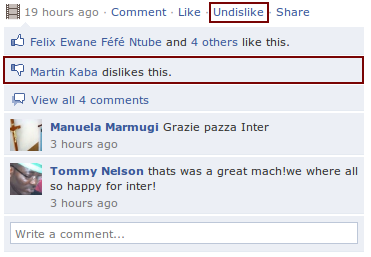 Oh, to have a "dislike" button on Facebook, to be able to tell your friends what you really think of their movie reviews or their complaints about the job when you know you work much harder than they do.
There is such a button being offered around on Facebook, but it is not the real thing. Not only is it not the real thing — it's a rogue application, and if you give it permission to access your profile, it will post spam messages from your account. It will ask you to complete an online survey, which generates money for the wisenheimers who dreamed this scam up.
You may see postings on your Facebook wall purportedly from your friends who may have bitten on this one. And who can blame them? The social networking site lets users click on a "like"  button with a "thumbs up" icon, or post comments about comments, but still, to date, there is no one-click way to transmit the sentiment: "No, I don't like this!"
Graham Cluley, a senior technology consultant with software security firm Sophos, based in Britain, sounded the alert on his company's blog, noting that "it's the latest survey scam spreading virally across Facebook, using the tried-and-tested formula used in the past by other viral scams." Past successful scams include such lures as Justin Bieber flirting, the world's biggest and scariest snake and the "world's worst McDonald's customer."
 You might see messages posted on your wall saying, "Get the official DISLIKE button NOW!" or "I just got the Dislike button, so now I can dislike all of your dumb posts lol!!." Ignore, ignore, ignore and do not give the application permission to run, says Cluley.
"If you do give the app permission to run, it silently updates your Facebook status to promote the link that tricked you in the first place, thus spreading the message virally to your Facebook friends and online contacts," he wrote.
 "But you still haven't at this point been given a 'Dislike' Facebook button, and the rogue application requires you to complete an online survey." The survey will help make money for the scammers, and point you to a Firefox browser add-on for a "Dislike" button made by FaceMod as a Facebook add-on.
FaceMod, Cluley says, is not connected with the scam — "their browser add-on is simply being used as bait." Cluley says that if you are desperate to try the actual Dislike button (which his firm is in no way endorsing), be sure to get it only through the Firefox Add-ons Web page.
Part of the reason an offer for a "dislike" button is so alluring is because some Facebook users want one. More than 3 million of them have joined a group on Facebook to say so.
In a July interview with ABC, Facebook CEO Mark Zuckerberg said company officials would "definitely think about" adding a "Dislike" button. But like it or "dislike" it, it hasn't happened yet.


 The world’s largest tidal turbine was recently unveiled on August 11th 2010 at Invergordon, Scotland, weighing 130 tons, 74ft (22.6m) tall, with two 60ft (18.3m) diameter rotors and generating 1MW on both tidal ebb and flow. The Atlantis Resources AK1000 can supply power to 1000 homes, and is to be installed at the European Marine Energy Centre in the Orkney Islands, and has taken more than ten years to develop.
Atlantis Resources' chief executive Tim Cornelius explained that, " The turbines turn at six to eight revolutions per minute, so are incredibly slow turning and will have zero impact on the surrounding environment." Theoretically, the turbine rotors should not harm marine animals.
So what is Tidal Current Power?
Tidal current technology is a form of hydropower and harnesses the energy in tides and converts it into usable power.
Tidal current power is different from wave power. Wave power harnesses power of the waves while Tidal Current technology extracts energy from the high tide bulge created by the gravitational pull of the Moon and Sun moving horizontally around the Earth’s surface.
As per the Atlantis, Sea water, which is 832 times denser than air, gives a 5 knot ocean current more kinetic energy than a 350 km/h wind; therefore ocean currents have a very high energy density. Hence a smaller device is required to harness tidal current energy than to harness wind energy.
Tidal Power and Tidal current power differ in that, Tidal power requires the building of barrages to manage and direct the flow of the current etc… the civil construction cost and impact on the environment is much higher in the tidal power barrage systems.

Tidal Power facts:
On the whole the project sounds and looks really good and it has been working in Australia. Will wait to see how it works out in Orkney, Scotland.
 Thousands of people flocked to an exhibition in Japan on Sunday to see a capsule from the Hayabusa space probe which was hoped to have brought asteroid dust to Earth.
 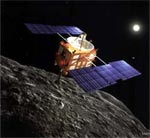 Some 1,800 people were queuing in Tokyo to see the heat-proof pod, which had travelled in space with the unmanned craft for seven years, even before the exhibition opened in the morning, a Japan Aerospace Exploration Agency (JAXA) spokesman said.
 More than 7,000 had visited the first public showing of the capsule by early evening, he said, adding that the space agency expects as many as 50,000 people during the five-day exhibition.
The capsule, which journeyed billions of kilometres (miles), was fired back to Earth in June.
Technical problems had plagued the Hayabusa, which at one stage spun out of control and lost contact with JAXA for seven weeks, delaying the mission for three years until the asteroid and Earth re-aligned.
When it finally latched onto the potato-shaped Itokawa asteroid, a pellet-firing system designed to stir up dust malfunctioned, leaving it unclear how much material the probe was able to gather.
 Scientists hope any dust samples from the ancient asteroid in the capsule could help reveal secrets about the origins of the solar system.
The space agency has said it found "minute particles" of what it hopes is asteroid dust in the capsule, but it is expected to take months to get the final results of the analysis.
The Hayabusa project has generated great excitement in Japan.
"I was so impressed that such a small thing came back to Japan after a seven-year space journey," said one of the visitors. "It is just amazing."


