



Spassky Cave Church in Russia
13 years ago


 Columbus Day some states declare this day as the Columbus Day holiday and people enjoy a day off from work and students don’t go to schools, on the other hand some of the states of the country don’t recognize this day and everything goes normally and no Columbus Day holiday is celebrated. The very reason for all this is that the exact birth date of Christopher Columbus is not known, according to people it is between the twenty fifth of August and the thirty first of October. We don’t know the exact date of birth of the discoverer of the American continent. In the most parts of the country the jobs that are affiliated with the American government are closed on the 11th of October. The 11th of October has been decided as the Columbus Day and normally this day is declared a holiday, but many organizations and states don’t recognize this day. The stocks will remain open today and if you also work in such a place then you have to go to work today, this shows that the corporate world does not recognize the Columbus Day. The United States is actually not the only one that is going to celebrate the Columbus Day today, many of other countries that include several of the European countries will also celebrate the Columbus Day.



BEIJING -- Top-seeded Novak Djokovic beat David Ferrer of Spain 6-2, 6-4 on Monday to successfully defend his China Open title.
The world No. 2 cruised through the first set of a match that had been rained out Sunday, before falling behind 4-2 in the second.
At 4-3, the eighth-ranked Ferrer battled to hold serve and defend his lead, but Djokovic was relentless, breaking him to take the set and, two games later, the match.
"I started off really well but then I lost the momentum, I kind of lost the rhythm, got him back into the match with some unforced errors," said Djokovic, who converted four of six break points while being broken only once to wrap up his second title of the season.
 "It wasn't a really nice looking match from both sides. We made a lot of unforced errors, especially him. He made my life a little bit easier at the end of the second set, where, with his unforced errors, I got back into the set," the Serb said.
Djokovic, runner-up at last month's U.S. Open, said he was pleased with his improved serve, which he says is largely responsible for the run of success he's experienced since Wimbledon.
The 23-year-old had somewhat more difficulty accounting for his success in Beijing, where he won the Olympic bronze medal in 2008 in addition to his back-to-back China Open titles. The playing surface -- and the local cuisine -- seem to suit his style of play, Djokovic said.
"There's something special about this place."
Djokovic now moves on to the ATP Masters in Shanghai, where he will face either Ivan Ljubicic of Croatia or Chinese qualifier Zhang Ze on Wednesday.
"This is definitely a confidence boost for me. The last two, three months ... feeling much more comfortable and confident on the court, playing the aggressive game and service is working for me which is a great thing to have," he said. "Let's see if I can keep it up. Energy-wise, I'm fresh."
Ferrer has less time to rest with a match against Frenchman Michael Llodra in Shanghai on Tuesday. He also pointed to the eighth game of the second set as having decided Monday's match.
"I had my chance there, but didn't do it," said the 28-year-old, who entered the final after beating Ljubicic in three sets in Saturday's semifinals. "Maybe when I lost this game, I lost a little bit my concentration and couldn't come back and play regular again."
New world No. 1 Caroline Wozniacki plays No. 3 Vera Zvonareva later Monday for the women's title. Zvonareva has won three of their previous five meetings.
The Simpsons, Thursday 21 October, 1930BST, Sky 1 HD and Sky 1
UK graffiti artist Banksy has created a controversial title sequence for long-running US animation The Simpsons.
The intro, which was shown in the US on Sunday, opens with the street artist's tag scrawled across the town of Springfield.
It closes with a minute-long sequence showing dozens of sweatshop workers in a warehouse painting cartoon cells and making Simpsons merchandise.
The episode, called MoneyBart, will be shown in the UK on 21 October.
It is the first time an artist has been invited to storyboard part of the show.
The extended sequence was apparently inspired by reports the show outsources the bulk of their animation to a company in South Korea.
Delays and disputes
It features Bart Simpson with his face covered as he writes all over his classroom walls.
While in the sweatshop, kittens are thrown into a wood chipper so their fur can be used to stuff Bart Simpson dolls and a chained unicorn is used to punch holes in Simpsons DVDs.
According to the street artist, his storyboard led to delays, disputes over broadcast standards and a threatened walk out by the animation department.
"This is what you get when you outsource," joked The Simpsons executive producer Al Jean.
Other famous Britons to have contributed to the show include Tony Blair, Simon Cowell and Ricky Gervais.
Gervais also wrote Homer Simpson, This Is Your Wife in 2006, and is to make another appearance on the show next year.
 UFO? Kite? New Chinese military aircraft? Whatever it was last month, it's still hovering in the news.
 Yesterday, the UFO reappeared — in the saucy British tabloid The Sun, renewing interest in the night lights over northeastern China. Accompanying a photo, The Sun wrote that a "major" airport "was forced to shut down to prevent packed passenger jets crashing into a UFO." Without citing a source, the paper described the object as, quote, "flat and tubular" (a seeming oxymoron ) and wrote that it "hovered two miles from Bootee" (its transliteration of Baotou). "Astonished officials say it then zoomed in to circle the airport before suddenly vanishing," according to The Sun.
 Last month's report was the ninth in three months, with at least eight sightings reported in several provinces between late June and late July. One in July that briefly closed an airport in Hangzhou turned out to be part of a military test at a nearby air base. Another UFO was just jet contrails, and one other was a kite.
WASHINGTON – A "hidden" language spoken by only about 1,000 people has been discovered in the remote northeast corner of India by researchers who at first thought they were documenting a dialect of the Aka culture, a tribal community in the foothills of the Himalayas.
They found an entirely different vocabulary and linguistic structure.
Even the speakers of the tongue, called Koro, did not realize they had a distinct language, linguist K. David Harrison said Tuesday.
Culturally, the Koro speakers are part of the Aka community in India's Arunachal Pradesh state, and Harrison, associate professor of linguistics at Swarthmore College, said both groups merely considered Koro a dialect of the Aka language.
But researchers studying the groups found they used different words for body parts, numbers and other concepts, establishing Koro as a separate language, Harrison said.
"Koro is quite distinct from the Aka language," said Gregory Anderson, director of the Living Tongues Institute for Endangered Languages. "When we went there we were told it was a dialect of Aka, but it is a distant sister language."
 People of the Aka culture live in small villages near the borders of China, Tibet and Burma (also known as Myanmar). They practice subsistence hunting, farming and gathering firewood in the forest and tend to wear ornate clothing of hand-woven cloth, favoring red garments. Their languages are not well known, though they were first noted in the 19th century.
The region where they live in the foothills of the Himalaya Mountains requires a special permit to enter. There, the researchers crossed a mountain river on a bamboo raft and climbed steep hillsides to to reach the remote villages, going door-to-door among the bamboo houses that sit on stilts.
Harrison and Anderson spoke at a news conference organized by the National Geographic Society, which supported their work.
The northeast corner of India is known as a hotspot of language diversity and researchers were documenting some of the unwritten tongues when they came across Koro in research started in 2008.
The timing of their discovery was important.
"We were finding something that was making its exit, was on its way out. And if we had waited 10 years to make the trip, we might not have come across close to the number of speakers we found," said Anderson.
Previously undocumented languages are "noticed from time to time" Harrison said, so such a discovery is not rare. But at the same time linguists estimate that a language "dies" about every two weeks with the loss of its last speakers.
Counting Koro there are 6,910 documented languages in the world, Harrison said. But he added that is really just a best estimate that can change regularly.
Many languages around the world are considered endangered, including Koro, he explained, because younger people tend to shift to the more dominant language in a region.
Unusually, Koro has been maintained within the Aka community, the researchers said, even though there is intermarriage and the groups share villages, traditions, festivals and food. In addition to the estimated 800 to 1,200 Koro speakers, the West Kameng and East Kameng districts of Arunachal Pradesh contain 4,000 to 6,000 Aka speakers.
The Koro speakers "consider themselves to be Aka tribally, though linguistically they are Koro. It's an unusual condition, such arrangement doesn't usually allow for maintenance of the minor language," Anderson said.
The threat, however, is from the spread of Hindi, a dominant language in India, and many youngsters go to boarding schools where they learn Hindi or English.
The researchers said they hope to figure out how the Koro language managed to survive within the Aka community.
They said Koro is a member of the Tibeto-Burman language family, a group of some 400 languages that includes Tibetan and Burmese. While Koro differs from Aka, it does share some things with another language, Tani, which is spoken farther to the east.
The research was started in 2008 to document two little known languages, Aka and Miji, and the third language, Koro, was discovered in that process.
"We didn't have to get far on our word list to realize it was extremely different in every possible way," Harrison said.
They said Koro's inventory of sounds was completely different, and so was the way sounds combine to form words. Words also are built differently in Koro, as are sentences.
The Aka word for "mountain" is "phu," while the Koro word is "nggo." Aka speakers call a pig a "vo" while to Koro speakers, a pig is a "lele."
"Koro could hardly sound more different from Aka," reported Harrison, author of a new book "The Last Speakers," about vanishing languages. Joining the two was linguist Ganesh Murmu of Ranchi University in India.
The researchers detail Koro in a scientific paper to be published in the journal Indian Linguistics.
LIMA (Reuters) – Archaeologists say scrawl on the back of a letter recovered from a 17th century dig site reveals a previously unknown language spoken by indigenous peoples in northern Peru.
 A team of international archaeologists found the letter under a pile of adobe bricks in a collapsed church complex near Trujillo, 347 miles (560 km) north of Lima. The complex had been inhabited by Dominican friars for two centuries.
"Our investigations determined that this piece of paper records a number system in a language that has been lost for hundreds of years," Jeffrey Quilter, an archaeologist at Harvard's Peabody Museum of Archaeology and Ethnology, told Reuters.
A photograph of the letter recently released by archaeologists shows a column of numbers written in Spanish and translated into a language that scholars say is now extinct.
"We discovered a language no one has seen or heard since the 16th or 17th century," Quilter said, adding that the language appears to have been influenced by Quechua, an ancient tongue still spoken by millions of people across the Andes.
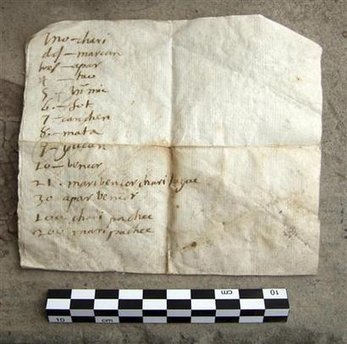 He said it could also be the written version of a language colonial-era Spaniards referred to in historical writings as pescadora, for the fishermen on Peru's northern coast who spoke it.
So far no record of the pescadora language has been found.
The letter, buried in the ruins of the Magdalena de Cao Viejo church at the El Brujo Archaeological Complex in northern Peru, was discovered in 2008.
But Quilter said archaeologists decided to keep their discovery secret until the research showing evidence of the lost language was published this month in the journal American Anthropologist.
"I think a lot of people don't realise how many languages were spoken in pre-contact times," Quilter said. "Linguistically, the relationship between the Spanish conquistadors and the indigenous was very complex."
 PLUM ISLAND, N.Y. – The classified ad might read: "Island for sale. Gem of a property, teeming with fish and wildlife, only a two-hour drive from nation's largest metro area. Features power plant, sewage treatment. Ripe for development."
What it might not say: "Site of animal disease research and germ warfare testing; old Army coastal defense post."
Plum Island held an open house of sorts for environmental leaders Wednesday as the federal government proceeds with plans to relocate its 50-year-old animal disease research laboratory to Kansas and sell the 840-acre pork chop-shaped island off the eastern tip of New York's Long Island.
The laboratory is modern and would not look out of place on any college campus, but the rest of the island is largely undeveloped with freshwater marshes, pristine beaches and seals resting on huge rocks just offshore. There is also an 1869 lighthouse (no longer in use) and buildings from a U.S. Army base that closed after World War II.
The visit was part of an ongoing effort by Plum Island brass to end the suspicion surrounding the island made famous in a 1997 Nelson DeMille best-selling book of the same name, and its mention as a possible home for Hannibal Lecter in the film "Silence of the Lambs."
"There has been, in the past, more secrecy about the facility," said lab director Dr. Larry Barrett, who noted more than a dozen community groups have visited this year. "This facility is not a threat to the nation, it's not a threat to anyone. The job here is to protect our nation against attacks on our livestock."
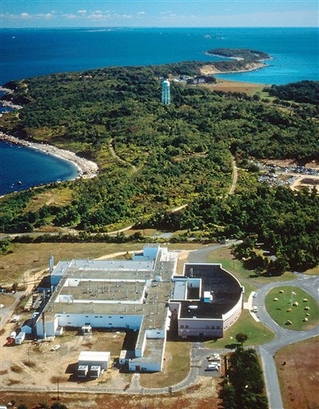 Agriculture Department scientists perform the lab studies, but the Department of Homeland Security has overseen the island and its security since 2003.
Because the island is a potential target for those who might want to steal dangerous pathogens or wreak havoc, visitors must undergo FBI background checks and all bags are inspected before anyone is permitted onto a ferry for the 1.5-mile trip. Armed guards check visitors leaving the island to ensure no food or other material is carried back to the populated areas.
Environmentalists peppered Plum Island officials with questions about sewage treatment, groundwater testing, whether surveys have been conducted on the impact a sale might have on wildlife and concerns about possible contamination. The officials were short on specific answers but promised a follow-up meeting.
"I was a little surprised by the lack of detailed environmental information so that was a little disappointing, said Adrienne Esposito, executive director of the Citizens Campaign for the Environment. "So we still have the same concerns. The same concerns about groundwater, soil, 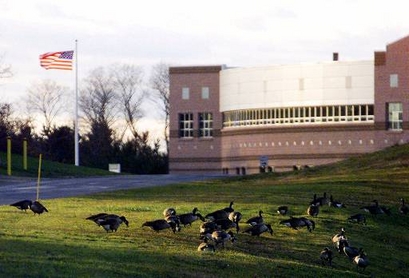 wetland contamination. We need to make sure that public health is protected as well as the natural assets."
Most of the environmentalists said they would support a research and development facility to replace the laboratory but were adamant that most of the island should remain in its natural state.
"It would be a terrible insult to the millions of people who live within an hour's drive of the (Long Island) Sound for this to be developed as a playground for the few, as opposed to making it a managed and loved place for the many," said Curt Johnson, program director of a group called Save the Sound.
He said the island has been identified as an exemplary site for fish and wildlife. Great Gull Island and Little Gull Island, both nearby, combined with Plum Island have a large population of nesting roseate terns, an endangered species, he added.
 "This is an incredible snapshot of what Long Island Sound looked like hundreds of years ago," Sandy Breslin, director of governmental affairs for Audubon Connecticut, said as she watched seals resting on rocks.
The General Services Administration, which is responsible for selling the island, is compiling a draft environmental impact statement, a preliminary step for any sale. Expected last month, the statement has been delayed until late November or early December to allow input from the Environmental Protection Agency and the Fish & Wildlife Service, GSA spokeswoman Paula Santangelo said.
Documents, some obtained this year by The Associated Press under the Freedom of Information Law, reveal that hundreds of tons of medical waste, contaminated soil and other refuse have been shipped off the island. Other island sites have been cleaned in compliance with federal regulations.
And the U.S. Army Corps of Engineers determined in 2006 that no munitions or ordnance remain from the Army base. As late as 2007, New York government inspection reports said there is no environmental threat on the island.
Despite talk of selling Plum Island, officials said a new lab in Manhattan, Kan., is not scheduled to open until 2018. Still pending is a congressional risk assessment of Homeland Security's decision to move the animal disease lab there; some lawmakers question the wisdom of studying 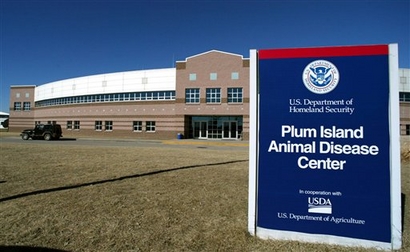 dangerous pathogens in the so-called Beef Belt. DHS has determined that an accidental release of foot-and-mouth disease would have a $4.2 billion impact on the economy, regardless of the lab's location.
Alan Schnurman, a real estate developer in the Hamptons on Long Island's east end, said he has heard estimates that Plum Island could fetch as much as $50 million.
"As a high-end real estate project, whether it's developed as a resort or for high-end individual homes, Plum Island is very appealing to a certain segment of the population," Schnurman said. "They should develop the area where the lab is located and set aside the rest for environmental purposes."


